Glossary
Meeting Minutes vs Meeting Notes: The Difference, With Examples
Updated · 6 min read
The difference between meeting minutes and meeting notes is purpose and formality. Meeting minutes are the official record of a meeting: attendance, motions, votes and decisions, written in neutral language, then approved by the group and kept. Meeting notes are an informal working record: whatever helps the people in the room remember context, ideas and next steps, in any format, with no approval step. Boards, committees and nonprofits need minutes; most team meetings only need notes.
Meeting minutes vs meeting notes at a glance
| Meeting minutes | Meeting notes | |
|---|---|---|
| Purpose | Official record of what the group decided | Help attendees remember and act |
| Who needs them | Boards, committees, nonprofits, councils, HOAs, shareholder meetings | Anyone: team syncs, 1:1s, client calls, workshops |
| Who writes them | A designated secretary or minute-taker | Any attendee, often several people |
| Format | Fixed: header, attendance, items, motions, actions, adjournment | Free-form: bullets, mind map, doc, whiteboard photo |
| Tone | Neutral, third person, past tense | Personal shorthand is fine |
| Level of detail | Outcomes, motions word for word, vote counts | Context, reasoning, ideas, quotes, questions |
| Approval | Reviewed and approved at the next meeting | None |
| Retention | Kept as part of the organization’s records | Kept as long as they are useful |
| Legal weight | Can serve as evidence of what was decided | Usually informal, though they can still be requested in disputes |
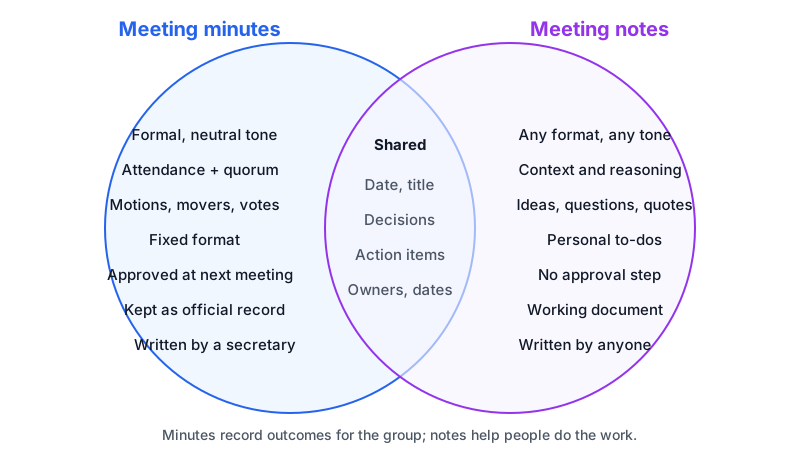
The same meeting written both ways
The clearest way to see the difference is to write up one meeting twice. Here is a 40-minute library friends’ group committee meeting where three things happened: the treasurer reported the balance, the committee voted to fund a summer reading prize, and someone volunteered to look into a new venue for the book sale.
Friends of Eastbrook Library — Committee Meeting Minutes
Date: 12 November 2026   Time: 18:30   Location: Library meeting room
Present: J. Ortiz (Chair), M. Chen (Treasurer), A. Bello, R. Novak, S. Patel (Secretary)
Absent: K. Hughes (apologies)
Quorum: present (5 of 6 members)

1. Call to order
   The Chair called the meeting to order at 18:32.

2. Approval of previous minutes
   The minutes of 8 October 2026 were approved without amendment.

3. Treasurer's report
   The Treasurer reported a balance of $4,820 as of 31 October.
   The report was received.

4. Summer reading prize
   MOTION: To allocate $600 to a summer reading prize for 2027.
   Moved: A. Bello   Seconded: R. Novak
   Result: Carried, 4 in favor, 0 against, 1 abstention.

5. Book sale venue
   The committee discussed moving the spring book sale to the
   community hall. No decision was taken.

Action items
- R. Novak to obtain hall rental terms — by 3 December 2026
- M. Chen to set up the prize budget line — by 30 November 2026

Next meeting: 10 December 2026, 18:30
Adjourned: 19:12
Minutes recorded by: S. Patel   Approved: ____________ (date)
Friends of library — committee, Nov 12

Money: ~$4.8k in the bank (Oct 31). Healthy, no concerns.

Reading prize: YES, $600 approved for summer 2027.
- Anita's idea: split into age groups? Talk to children's librarian.
- Raj abstained — thinks we should fund the book sale first.

Book sale venue: community hall?
- Pro: twice the floor space, parking
- Con: costs money, library space is free
- Raj checking rental terms

TODO
- Raj: hall rental terms (Dec 3)
- Mei: prize budget line (Nov 30)
- Me: ask children's librarian about age groups

Next: Dec 10
Notice what changes. The minutes add attendance, quorum, the exact motion, mover, seconder and vote count, and leave out opinions and who argued what. The notes drop the formalities but keep the reasoning (pros and cons of the venue, why someone abstained) and a personal to-do that does not belong in an official record. Both carry the same two action items with owners and dates.
When you need minutes and when notes are enough
| Meeting | Record | Why |
|---|---|---|
| Board of directors, trustees | Minutes | Bylaws and corporate law usually require a record of resolutions |
| Nonprofit or association committee | Minutes | Members and auditors rely on them; often required by the constitution |
| Council, school board, HOA | Minutes | Often a public or member record by rule |
| Annual general or shareholder meeting | Minutes | Votes and elections must be documented |
| Team weekly or standup | Notes | Only the team uses them; decisions and owners are enough |
| One-on-one | Notes | Private working record, often shared just between two people |
| Client or sales call | Notes, plus a recap email | The client needs agreed next steps, not a formal record |
| Project steering committee | Lightweight minutes | Decisions on scope and budget may be revisited later |
How to turn notes into minutes
Add the formal header
Organization, meeting type, date, time, location, chair, and who took the minutes.
Record attendance and quorum
Present, absent with apologies, guests, and whether a quorum was reached.
Reduce each topic to its outcome
One or two neutral sentences per agenda item. Remove opinions, names attached to arguments and side conversations.
Write motions word for word
Exact wording, mover, seconder and the result with vote counts. This is where a recording helps most.
List action items, then circulate for approval
Task, owner and due date, then send the draft to the chair and put “approve previous minutes” on the next agenda.
For a full template with every section, see how to write meeting minutes; for board-specific rules such as executive session, see board meeting minutes. If your group uses the abbreviation, MOM (minutes of meeting) means the same thing as minutes. For informal notes, how to take meeting notes covers methods like Cornell and outline notes.
Writing both from one recording
A recording lets one person write either version afterwards instead of choosing during the meeting. AI Note Taker records on your iPhone or in the browser without a bot joining the call, then gives you a speaker-labeled transcript, an AI summary with decisions and action items with owners and due dates. The summary is closer to notes; use the transcript to check motion wording and vote counts when you write formal minutes, and remember the AI output is a draft, not approved minutes. The free plan includes unlimited recordings and transcriptions and one AI analysis.
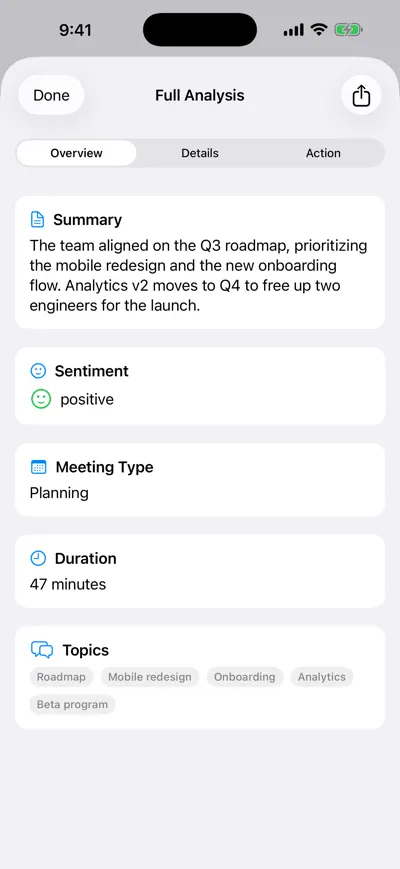
AI summary, the raw material for notes
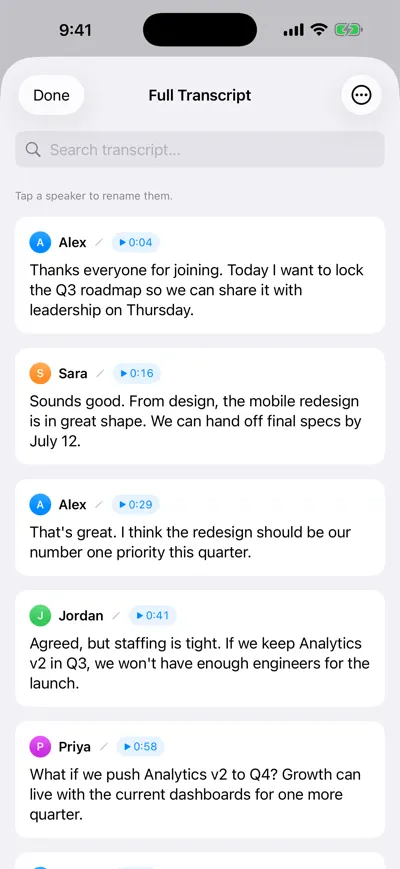
Transcript to check exact motion wording
Frequently asked questions
Let AI take the notes for you
AI Note Taker records and transcribes your meetings, then writes the summary, decisions and action items. Free to start, no install needed.