Templates
Board Meeting Minutes Template: How to Write Them (With Example)
Updated · 10 min read
A board meeting minutes template gives the secretary a fixed structure for the formal record: date, time and place, who presided, attendance and quorum, approval of prior minutes, every motion with its mover and vote result, any recusals, and the adjournment time, followed by the secretary’s signature. Good board minutes record what the board decided, not what each director said. Below are three copyable templates (corporate, nonprofit and HOA), a filled-in nonprofit example and the process from draft to signed record.
What board meeting minutes must include
Corporate, nonprofit, HOA, school and association boards share the same core elements. State law, your bylaws and open-meeting rules may add more (a public body may have to note each member’s vote). As a baseline, include:
Board minutes checklist
- Full legal name of the organization and type of meeting (regular, special, annual).
- Date, start time and place, or the video platform for a remote meeting.
- Who presided and who recorded the minutes.
- Directors present and absent, officers and guests attending, and a statement that a quorum was present.
- Confirmation that notice was given, if your bylaws require it (especially for special meetings).
- Approval of the previous meeting’s minutes, with any corrections.
- Reports received (treasurer, committees), noted briefly and attached.
- Each motion: exact wording, who moved it, the vote result, and the seconder if your board records it.
- Conflict-of-interest disclosures and recusals: who, on which item, and that they did not vote.
- Executive session: the time it started and ended and its general purpose, with no details.
- Time of adjournment.
- Signature of the secretary and, if your board does it, the chair, plus the date of approval.
Robert’s Rules basics for recording motions
Most boards follow some version of Robert’s Rules of Order. You only need to know which part of each motion goes on the record.
| Stage | What happens | What to record |
|---|---|---|
| 1. Motion | A director says “I move that…” | The exact wording and the mover’s name. Ask the chair to restate it if unclear. |
| 2. Second | Another director says “Second.” | Robert’s Rules does not require the seconder’s name, but many boards record it. Follow your board’s habit. |
| 3. Discussion | The chair states the motion; directors debate it. | Usually nothing, or one neutral line. Record amendments that are adopted. |
| 4. Vote | The chair calls for ayes, nays and abstentions. | The method (voice, show of hands, roll call, ballot) and the count, e.g. “carried 7–1, 1 abstention”. |
| 5. Result | The chair announces the result. | Carried, failed, tabled or referred to committee. On a roll call, each director’s vote. |
A director who voted against a motion may ask that their dissent be recorded by name. Do it: in some jurisdictions a recorded dissent can matter for a director’s personal liability.
Action minutes vs. discussion minutes
Action minutes record only what the board did: motions, votes, reports received and assignments. Discussion minutes add a short, neutral summary of the reasons behind a decision. Most boards are best served by action minutes plus a sentence of context on major decisions, showing the board was informed: “The board reviewed three bids and the facilities committee’s recommendation before voting.”
What not to include
- Verbatim arguments or “he said, she said.” Minutes are not a transcript, and quotes invite disputes about what was meant.
- Opinions, adjectives and tone. “Heated debate” or “the treasurer’s excellent report” do not belong in the record.
- Privileged legal advice. Write “The board received legal advice from counsel regarding the lease dispute,” not what counsel said. Detailing it may waive privilege.
- Personal or sensitive information about employees, residents or students beyond what the decision requires.
How to write board minutes, from draft to approval
Prepare before the meeting
Turn each agenda item into a heading and pre-fill the director list. Note the bylaws’ quorum number. If you also write the agenda, start from a meeting agenda template.
Capture motions and votes live
Focus on motions, votes, recusals and start and end times. Do not try to write down the discussion.
Draft within 48 hours
Check names, amounts and motion wording against your notes or a recording while memory is fresh.
Send to the chair for review
The chair checks accuracy but should not rewrite what happened.
Circulate the draft to the board
Mark every page “DRAFT, not yet approved” and include it in the next meeting’s board packet.
Approve at the next meeting
The board approves them as presented or as corrected, which is recorded in the new meeting’s minutes.
Sign and archive
The secretary signs the approved version, which goes into the minute book with attachments. Many organizations keep board minutes permanently.
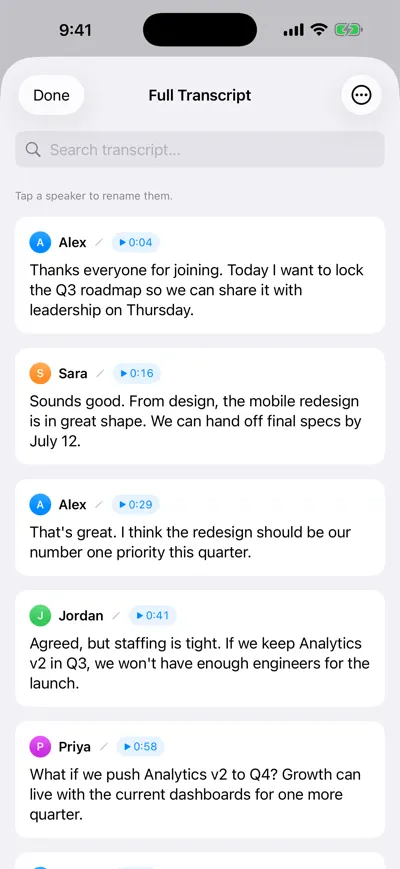
Check who said what, and when
Board meeting minutes templates
[COMPANY LEGAL NAME]
Minutes of the [Regular / Special] Meeting of the Board of Directors

Date: [Date]   Time: [Start time]   Place: [Address / video platform]
Presiding: [Name], Chair      Recording: [Name], Secretary

DIRECTORS PRESENT: [Names]
DIRECTORS ABSENT: [Names]
ALSO PRESENT: [Officers, counsel, guests]
Notice: Given on [date] in accordance with the bylaws.
Quorum: [#] of [#] directors present; quorum confirmed.

1. CALL TO ORDER at [time] by [Chair].
2. APPROVAL OF MINUTES of [date]: approved [as presented / as corrected: ...].
3. CONFLICTS OF INTEREST: [None declared / Name declared an interest in item #, left the room and did not vote].
4. REPORTS: CEO report and CFO financial report received (attached as Exhibits A and B).
5. RESOLUTIONS
   RESOLVED, that [exact wording].
   Moved: [Name]  Seconded: [Name]
   Vote: For [#]  Against [#]  Abstain [#]. Resolution [adopted / failed].
6. EXECUTIVE SESSION from [time] to [time] to discuss [general topic, e.g. personnel]. No action taken.
7. ADJOURNMENT at [time].

______________________   Date approved: [Date]
[Name], Secretary
[ORGANIZATION NAME]
Board of Directors, [Regular / Special / Annual] Meeting Minutes

Date: [Date]   Place: [Location / video link]
Called to order: [Time] by [Name], Board Chair
Minutes recorded by: [Name], Secretary

PRESENT: [Names]
ABSENT: [Names, excused / unexcused]
STAFF AND GUESTS: [Executive Director, others]
Quorum: Present ([#] of [#] voting directors)

1. CONSENT AGENDA (prior minutes of [date], committee reports): approved.
2. CONFLICT-OF-INTEREST DISCLOSURES: [None / details and recusal].
3. TREASURER’S REPORT: [Key figures, e.g. cash on hand, budget vs. actual]. Received and filed.
4. EXECUTIVE DIRECTOR’S REPORT: Received (attached).
5. MOTIONS
   Motion: "[Exact wording]"
   Moved: [Name]  Seconded: [Name]
   Result: [Carried / Failed], For [#] Against [#] Abstain [#]
6. ACTION ITEMS
   - [Task], [Owner], due [Date]
7. EXECUTIVE SESSION: [Time] to [time], [general purpose].
8. NEXT MEETING: [Date, time, place]
9. ADJOURNED: [Time]

Signed: ______________________ Secretary   Approved on: [Date]
[ASSOCIATION NAME] Board of Directors
[Open / Executive] Session Minutes

Date: [Date]   Time: [Time]   Location: [Clubhouse / video link]
Presiding: [Name], President
Directors present: [Names]   Absent: [Names]
Management present: [Company, manager name]
Quorum of the board: Confirmed
Notice of meeting posted on [date] per [bylaws / state law].

1. CALL TO ORDER: [Time]
2. OWNER OPEN FORUM: [#] owners spoke on [topics]. No action taken.
3. APPROVAL OF MINUTES of [date]: [Approved / approved as corrected]
4. FINANCIAL REPORT: Operating balance $[ ], reserve balance $[ ], delinquencies $[ ].
5. MANAGER’S REPORT: Received.
6. MOTIONS
   Motion: "[Exact wording, e.g. approve vendor contract up to $X]"
   Moved: [Name]  Seconded: [Name]
   Vote: [Carried / Failed] [#]-[#]-[#] [roll call if required]
7. EXECUTIVE SESSION: Board met in executive session on [date/time] regarding [delinquencies / legal / contracts]. [Actions taken, stated generally.]
8. NEXT MEETING: [Date]
9. ADJOURNMENT: [Time]

Secretary: ______________________   Approved: [Date]
Nonprofit board meeting minutes example
HARBOR LITERACY PROJECT
Board of Directors, Regular Meeting Minutes

Date: October 14, 2026   Place: Eastside Library Community Room and Zoom
Called to order: 6:03 pm by Denise Okafor, Board Chair
Minutes recorded by: Mark Feldman, Secretary

PRESENT: D. Okafor, M. Feldman, R. Patel (Treasurer), L. Gomez, S. Whitaker, J. Lin (via Zoom), T. Brennan
ABSENT: A. Mbeki (excused)
STAFF: Carla Ruiz, Executive Director
Quorum: Present (7 of 8 voting directors)

1. CONSENT AGENDA (minutes of September 9, program committee report): approved unanimously.
2. CONFLICT-OF-INTEREST DISCLOSURES: L. Gomez disclosed that her firm submitted a bid for the website redesign (item 5b). She left the room for that item and did not vote.
3. TREASURER’S REPORT: R. Patel reported $184,200 cash on hand and year-to-date expenses at 71% of budget. Received and filed.
4. EXECUTIVE DIRECTOR’S REPORT: Received (attached). Fall tutoring enrollment is 312 students.
5. MOTIONS
   a. Motion: "Approve the FY2027 operating budget of $642,000 as presented."
      Moved: R. Patel  Seconded: S. Whitaker
      Result: Carried, For 6 Against 1 Abstain 0. T. Brennan asked that his vote against be recorded.
   b. Motion: "Award the website redesign contract to Brightline Studio for up to $18,500."
      Moved: J. Lin  Seconded: M. Feldman
      Result: Carried, For 6 Against 0 Abstain 0 (L. Gomez recused).
6. ACTION ITEMS
   - Send signed budget to the auditor, C. Ruiz, due October 21
7. EXECUTIVE SESSION: 7:22 pm to 7:48 pm, to discuss the Executive Director’s annual review. No action taken.
8. NEXT MEETING: November 11, 2026, 6:00 pm, Eastside Library
9. ADJOURNED: 7:51 pm

Signed: Mark Feldman, Secretary   Approved on: November 11, 2026
Note that the 20-minute budget debate became a vote count, Brennan’s dissent is recorded because he asked, and the executive session shows only time and purpose. Follow-up tasks use the usual rules for meeting action items: one owner, one date.
Should boards record their meetings?
Some boards record every meeting, some forbid it, and public bodies may have to record and retain open sessions. Some places require everyone’s consent to record. Check your bylaws and local law, and talk to counsel before adopting a policy. This is not legal advice.
Recording board meetings
Pros
- The secretary can verify motion wording, names and numbers instead of relying on memory.
- The secretary can take part in the discussion instead of only writing.
- Directors who missed the meeting can catch up on context.
Cons
- A recording can be requested or subpoenaed in litigation, like other records.
- Directors may speak less candidly when they know they are recorded.
- Recordings can conflict with the minutes and confuse which is the official record.
A common compromise is to record only as a drafting aid: the board adopts a written policy that the secretary may record open sessions, never executive sessions, and that the recording is deleted once the minutes are approved, so the approved minutes remain the only official record. Whether this fits you depends on your jurisdiction, any legal holds and public-records obligations, so confirm it with counsel first.
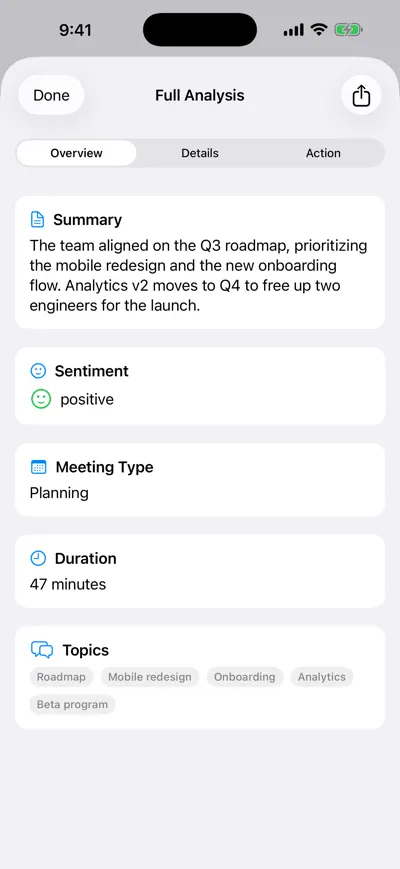
AI summary as a first draft
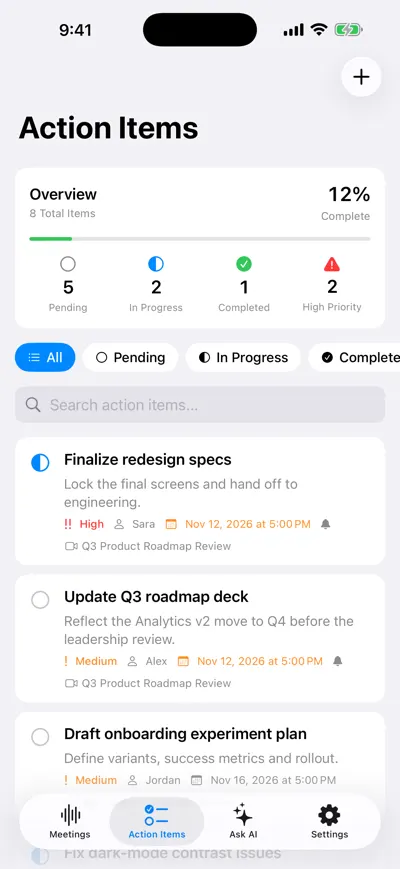
Follow-up tasks with owners and dates
Frequently asked questions
Let AI take the notes for you
AI Note Taker records and transcribes your meetings, then writes the summary, decisions and action items. Free to start, no install needed.