Templates
One on One Meeting Template: Agendas, Questions and Notes
Updated · 10 min read
A good one on one meeting template is a shared, running document with three parts: the report’s topics first, the manager’s topics second, and a list of commitments carried from one meeting to the next. Below you’ll find that recurring 1:1 agenda plus four more templates (first 1:1, career, performance, employee prep sheet), 45 questions worth asking, and how to keep notes that actually get followed up.
What a 1:1 is for (and what it isn’t)
A one-on-one is a recurring private conversation between a manager and a direct report. Its job is to surface what doesn’t come up anywhere else: a blocker someone is embarrassed about, friction with a teammate, a career goal, early signs of burnout, feedback in both directions. If your 1:1s are mostly status updates, move those to a standup or a message.
For managers: your job is to listen more than talk, ask follow-up questions, and leave with fewer open loops than you started with. For employees: you own the agenda. Bring the topics you want help with, and don’t wait for your manager to ask the right question.
How often and how long: 1:1 cadence
| Situation | Frequency | Length | Notes |
|---|---|---|---|
| Default for most direct reports | Weekly | 30 min | Move it if you must; avoid cancelling. |
| Senior or very independent reports | Every two weeks | 45–60 min | Longer slot leaves room for strategy and career topics. |
| New hire, first 90 days | Weekly (or twice weekly in month one) | 30 min | Add a 30/60/90-day check-in on goals. |
| Skip-level (your manager’s reports’ reports) | Monthly or quarterly | 30–45 min | Focus on team health and ideas, not individual performance. |
| Career/growth conversation | Quarterly | 45–60 min | Replace one regular 1:1; don’t stack on top. |
Recurring 1:1 agenda template
Use one shared doc per person. Both of you add topics during the week, so the meeting starts with an agenda instead of “so… what’s up?” Add each new meeting at the top.
1:1 — [Report name] / [Manager name]
Cadence: weekly, [day + time], 30 min

OPEN COMMITMENTS (carry forward until done)
- [ ] [Task] — [Owner] — [Due date] — added [date]
- [ ] [Task] — [Owner] — [Due date] — added [date]

=== [Date] ===
1. Check-in (2 min)
   How are you, honestly? (1–5 or one word)

2. [Report]’s topics (15 min)
   -
   -

3. [Manager]’s topics (8 min)
   -
   -

4. Feedback (3 min)
   One thing going well / one thing to change — both directions

5. Commitments (2 min)
   - [Task] — [Owner] — [Due date]

Notes:
-

=== [Previous date] ===
...
Four more one on one templates
First 1:1 with a new direct report
The first meeting sets expectations for every 1:1 after it. Spend it learning how they work, not reviewing projects.
FIRST 1:1 — [Name] — [Date] — 45 min

1. Background (10 min)
   - What have you worked on that you’re proudest of?
   - What did your best manager do that you’d want from me?

2. How you work (10 min)
   - How do you prefer to get feedback: written, live, in the moment?
   - When are you most and least focused?
   - How will I know you’re stressed or stuck?

3. Expectations (15 min)
   - What I expect: [2–3 points]
   - What you can expect from me: [2–3 points]
   - What does success look like at 30 / 60 / 90 days?

4. How we’ll run 1:1s (5 min)
   - Cadence, shared doc, your topics first

5. Commitments
   - [Task] — [Owner] — [Due date]
Career and growth 1:1
CAREER 1:1 — [Name] — [Date] — 60 min (quarterly)

1. Where you want to be
   - In 2–3 years, what job would you love to have?
   - Which parts of your current work give you energy? Which drain it?

2. Gap check
   - Skills or experience needed for that next step: [list]
   - Strongest today: [ ]   Biggest gap: [ ]

3. Next 90 days
   - One stretch project or responsibility: [ ]
   - One skill to build, and how: [course / mentor / shadowing]
   - Who should see your work? [people / forums]

4. What I’ll do
   - [Manager commitment] — [Due date]

Review date: [date of next career 1:1]
Performance check-in
PERFORMANCE CHECK-IN — [Name] — [Date]

Goals this period
| Goal | Status (on track / at risk / done) | Evidence |
|------|-----------------------------------|----------|
|      |                                   |          |

What’s working (specific examples)
-

What needs to change (specific examples + impact)
-

Support needed from manager
-

Agreed next steps
- [Action] — [Owner] — [Date]

Employee comments
-
Employee 1:1 prep sheet
If you’re the report, fill this in five minutes before each 1:1.
MY 1:1 PREP — [Date]

Wins since last time (things my manager might not know about):
-

Where I’m stuck or need a decision:
-

Something I want feedback on:
-

Something I want to raise (process, team, workload):
-

My commitments from last time — done?
- [ ]

The one thing I most want out of this meeting:
-
One on one meeting questions (45 that work)
Don’t run through a list. Pick one or two that fit the week, then ask “what else?” and wait.
Check-in
- On a scale of 1–5, how was your week? What would have made it one point higher?
- What’s taking up most of your headspace right now?
- What did you do this week that you’re glad you did?
- Is there anything you’ve been meaning to bring up but haven’t?
- What’s one thing I should know that I probably don’t?
- Was there a moment this week you felt frustrated? What happened?
Priorities and focus
- If you could only finish one thing this week, what would it be?
- What are you working on that you think doesn’t matter?
- Are your priorities clear? Where do they conflict?
- What would you stop doing if I gave you permission?
- Where are you spending time that doesn’t show up in any plan?
- Which deadline worries you most?
Blockers
- What’s slowing you down that I could remove?
- Who are you waiting on, and for what?
- What decision do you need from me or someone else?
- Where did you have to work around a process this week?
- Is there something you’re stuck on but feel you should already know how to do?
- What would you need to go twice as fast on this project?
Feedback (both ways)
- What’s one thing I could do differently to make your work easier?
- Was there a time recently when I wasn’t helpful? What should I have done?
- Am I giving you too much, too little or about the right amount of direction?
- What feedback have you been holding back, for me or the team?
- Can I share some feedback on [specific thing]? (Then ask: how does that land?)
- What’s something you did recently that you’d like recognition for?
- How do you think the [project/presentation] went? What would you change?
Growth and career
- What skill do you want to be known for a year from now?
- Which part of your job would you happily do more of?
- Whose job, inside or outside the company, looks interesting to you?
- What’s a project you’d raise your hand for if it came up?
- What did you learn this month?
- Is there something you want to try that you think you’re not ready for?
Wellbeing and workload
- How sustainable does your current pace feel?
- When did you last fully switch off from work?
- Is your workload heavier, lighter or about the same as a month ago?
- Is anything outside work affecting how you’re doing here? (You don’t have to share details.)
- What drains your energy the most right now?
- Do you have enough focus time? What interrupts it?
Team and company
- Who on the team has been especially helpful lately?
- Is there any tension on the team I might not be seeing?
- What’s one thing about how we work as a team you’d change?
- Which meeting would you cancel if you could?
- Do you understand why we’re prioritizing [initiative]? Do you agree?
- What’s a rumor or question going around that I should address?
- If you were running this team, what would you do first?
- How connected do you feel to the rest of the team, especially if you’re remote?
1:1 notes and follow-up
1:1s feel useful when the things discussed in them actually happen. Keep a running list of commitments at the top of the shared doc and review it in the first two minutes of every meeting. Give each one an owner and a date, the same way you would for any meeting action item. Manager commitments matter most. If you promise to check on conference budget and never do, your report learns raising things is pointless.
Before
Both people add topics to the shared doc during the week. The report reviews the open commitments list.
During
Take light notes: topics, decisions, commitments. Don’t type while someone is telling you something hard. Listen, then write a line afterwards.
Right after
Add new commitments with owners and dates. Move done items to the meeting’s notes so the open list stays short.
Next meeting
Open with the commitments list. Anything carried over twice gets a real conversation: still needed, blocked, or drop it?
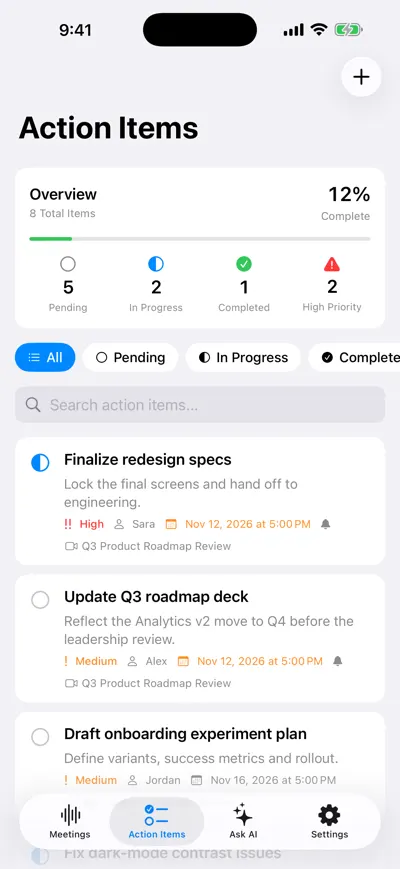
Commitments with owners and due dates
What not to write down
Shared 1:1 docs live for years and may be seen by HR or a future manager. Keep out: health and medical details, family or relationship situations, mental health disclosures, immigration status, and anything said in confidence about a colleague. Write the work-relevant outcome instead (“Priya will work reduced hours through March; coverage plan agreed”) rather than the reason. Harassment, discrimination or legal issues go through your HR process, not the 1:1 doc.
Should you record a 1:1?
Usually not by default: a recorder changes what people say, and 1:1s depend on candor. Always ask first, make it easy to say no, and stop recording if the conversation turns personal. Recording consent laws vary by country and US state, so check what applies to you (this isn’t legal advice). Recording helps when both people want it: remote reports who can’t take notes while talking, long coaching or career sessions worth revisiting, or a report working in their second language.
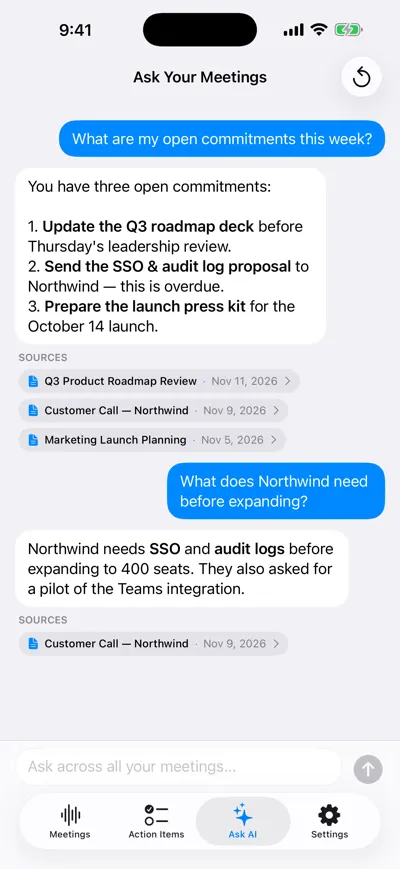
Ask AI across all meetings
Common 1:1 mistakes to avoid
Check your 1:1s against this list
- Cancelling or rescheduling more often than once a month
- Spending the whole time on project status updates
- The manager talks more than half the time
- No shared doc, so nobody remembers what was agreed last time
- Saving all feedback for the annual review
- Checking Slack or email during the meeting
- Manager commitments that never get followed up
- Using the same five questions every week until answers become automatic
For other recurring meetings, see the meeting agenda template and the general guide to taking meeting notes.
Frequently asked questions
Let AI take the notes for you
AI Note Taker records and transcribes your meetings, then writes the summary, decisions and action items. Free to start, no install needed.