Templates
Brainstorming Meeting Template: Techniques, Script and Idea Sheet
Updated · 10 min read
A brainstorming meeting template separates the session into two phases that should never overlap: diverging (generating as many ideas as possible, silently and without critique) and converging (grouping, voting and committing to a few ideas with owners). Open discussion where everyone shouts ideas is the least productive way to brainstorm, because the loudest and most senior voices anchor the room. Below is a 60-minute plan, a facilitation script you can read out loud, four techniques with exact timings, and a capture sheet that turns sticky notes into next steps.
Before the brainstorming meeting: frame the question
Most brainstorms fail before they start, because the question is either too vague (“How do we grow?”) or already contains the answer (“How might we add a referral program?”). Rewrite the problem as a How might we question: it should name who it is for, what outcome you want, and leave room for more than one answer.
| Too broad | Too narrow | Just right |
|---|---|---|
| How might we improve onboarding? | How might we add a welcome video? | How might we get new users to their first finished project in under 10 minutes? |
| How might we reduce churn? | How might we send a discount email before renewal? | How might we show small teams the value they got this month before they decide to renew? |
| How might we have better meetings? | How might we ban laptops in meetings? | How might we cut our weekly team meeting from 60 to 30 minutes without losing decisions? |
- Invite 4–8 people. Fewer and you run out of perspectives; more and people hide. Mix roles: someone close to the customer, someone who will build it, someone new who does not know “why we can’t”.
- Send a short brief 24 hours ahead: the question, two or three facts or data points, the constraints (budget, timeline, what is off the table), and what happens to the ideas afterwards.
- Ask for solo thinking in advance. Five minutes of individual idea-jotting before the meeting gives quieter people a head start.
- Name a facilitator who does not pitch. The facilitator runs the clock and the rules. If the most senior person facilitates, their ideas still win.
Brainstorming techniques that work in meetings
You do not need a dozen methods. These four cover one full session: one question, two ways to generate ideas, one way to choose. Pick brainwriting for written or strategic problems and Crazy 8s for anything visual (screens, layouts, packaging, signage).
| Technique | How it works | Time | Best for |
|---|---|---|---|
| How might we | Rewrite the problem as an open question; optionally generate several HMW questions and vote on one | 5–10 min | Framing the session; resetting a stuck discussion |
| Brainwriting (6-3-5) | Each person writes 3 ideas in 5 minutes, then passes the sheet; the next person builds on them. Six people and six rounds can yield over 100 ideas | 15–30 min | Strategy, messaging, process problems; groups with dominant voices |
| Crazy 8s | Fold a sheet into 8 panels and sketch 8 variations in 8 minutes, one per minute | 8 min + 10 min sharing | UI, product, visual and physical design |
| Dot voting | Everyone gets 3 dots (stickers or a digital equivalent) to place on the ideas they would test first; multiple dots on one idea allowed | 5 min | Converging fast without a debate |
Brainwriting 6-3-5 is usually credited to the German marketing expert Bernd Rohrbach (1968). Crazy 8s comes from the design sprint process popularized by Google Ventures. In a remote session, run both on a shared whiteboard with one column or frame per person; the rules stay the same.
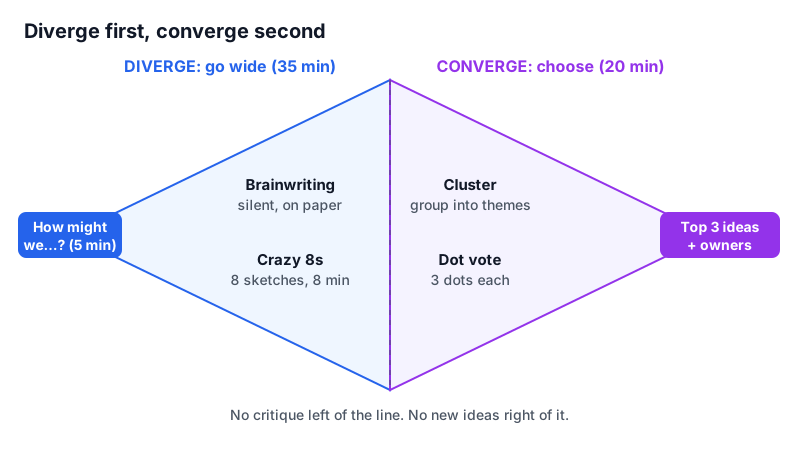
Brainstorming meeting agenda (60 minutes)
Brainstorm: How might we [question]? — [Date], 60 min
Facilitator: [Name]   Note taker: [Name]   Decider: [Name]
Outcome: 3 ideas, each with an owner and a small test to run by [date]
Pre-read: brief with facts and constraints (5 min) — [link]

0:00  Frame: the question, constraints, what "good" looks like (5 min)
0:05  Warm-up: 2-min "worst possible idea" round (3 min)
0:08  Diverge 1 — brainwriting, 3 rounds of 5 min (15 min)
0:23  Diverge 2 — Crazy 8s on the strongest themes (8 min)
0:31  Share: each person shows their top 2, no critique (9 min)
0:40  Converge — cluster into themes, name each theme (6 min)
0:46  Dot vote: 3 dots each (4 min)
0:50  Top 3: what would we test first, who owns it? (8 min)
0:58  Close: read back owners and dates (2 min)
Facilitation script you can read out loud
New facilitators tend to over-explain or forget a rule. This script covers each transition in a few sentences. Adapt the wording, but keep the rules about judging, crossing out and saving “but” for later: they prevent the most common failure modes.
OPEN (0:00)
"Thanks for coming. Our question today is: How might we [question]?
Here's what we know: [2–3 facts]. Here's what's off the table: [constraints].
By the end we'll have three ideas, each with an owner and a small test.
Two rules. While we generate, nobody judges ideas, including your own.
Quantity beats quality for the next 30 minutes."

WARM-UP (0:05)
"For two minutes, write the worst possible idea for this problem. Go."
(Read a few out. Laughter is the point. Bad ideas sometimes flip into good ones.)

BRAINWRITING (0:08)
"Write three ideas on your sheet, one per row. Five minutes, silently.
When I call time, pass your sheet to the right. Read what's there and
add three new ideas, or build on the ones above. No crossing out."
(Three rounds. Call time at 4:00 with "one minute left".)

CRAZY 8s (0:23)
"Fold your paper into eight panels. Pick a theme you like from the sheets.
Sketch eight different versions, one per minute. Stick figures are fine.
I'll call each minute."

SHARE (0:31)
"Each person: show your two favorite ideas in under a minute.
Others: questions to understand only. Save 'but' for later."

CLUSTER (0:40)
"Now we switch modes. We stop adding ideas and start choosing.
Let's group similar ideas. Name each group with a short verb phrase."

DOT VOTE (0:46)
"Three dots each. Vote for ideas you'd test first, not ideas you like most.
You can stack dots. [Decider] votes last so nobody follows them."

COMMIT (0:50)
"For the top three: what's the smallest test that would tell us
if this works? Who owns it? When will we know?"

CLOSE (0:58)
"Read-back: [idea] — [owner] — [test] — [date]. Everything else goes
in the idea sheet and nothing gets thrown away. Thank you."
Idea capture sheet template
Sticky notes get thrown away and whiteboards get wiped. The capture sheet is the permanent record of the session, and it is what you will come back to in three months when someone asks “didn’t we already think about this?”. Fill it in right after the meeting, while the photos and the transcript are fresh.
IDEA CAPTURE SHEET
Session: How might we [question]?
Date: [Date]   Participants: [Names]   Facilitator: [Name]
Raw ideas generated: [#]   Themes: [#]   Photos / board: [link]

THEMES AND IDEAS
Theme A: [name]
  - [Idea] (dots: [#]) — [one-line description]
  - [Idea] (dots: [#])
Theme B: [name]
  - [Idea] (dots: [#])

TOP 3 → TESTS
#  Idea      Smallest test                Success signal          Owner    Due
1  [Idea]    [what we'll try]             [what we'll measure]    [Name]   [Date]
2  [Idea]    [test]                       [signal]                [Name]   [Date]
3  [Idea]    [test]                       [signal]                [Name]   [Date]

PARKED (good, not now): [ideas + why parked]
OPEN QUESTIONS: [questions that need data or another team]
FOLLOW-UP SESSION: [date, if any]
Filled-in example: onboarding brainstorm
A product team at a fictional project-management startup ran the agenda above with six people. Brainwriting produced 54 ideas, Crazy 8s added 48 sketches, and clustering reduced everything to seven themes.
IDEA CAPTURE SHEET
Session: How might we get new users to their first finished project in under 10 minutes?
Date: November 10, 2026   Participants: Priya (PM), Marco (design), Lena (eng),
Sam (support), Jo (sales), Wei (new hire, week 2)   Facilitator: Dana
Raw ideas generated: 102   Themes: 7   Board: link

THEMES AND IDEAS (top 3 themes shown)
Theme A: Start from something real
  - Import a spreadsheet as the first project (dots: 6)
  - Pre-filled sample project the user edits instead of a blank screen (dots: 4)
Theme B: Fewer choices on day one
  - Hide integrations and settings until the first project is done (dots: 4)
  - One-question setup: "What are you planning?" (dots: 2)
Theme C: Human help at the right moment
  - Support chat opens if a user is idle on the empty project for 60 s (dots: 2)

TOP 3 → TESTS
1  Spreadsheet import first  Prototype + 5 user tests          4 of 5 finish in <10 min   Marco  Nov 24
2  Sample project            A/B test on 20% of sign-ups        +10% first-project rate    Lena   Dec 8
3  Hide settings on day 1    Remove 3 menu items for new users  No rise in support tickets  Priya  Dec 1

PARKED: video walkthrough (tried in 2025, low completion); gamified checklist (needs design capacity in Q1)
OPEN QUESTIONS: How many sign-ups already have a spreadsheet? (Sam to pull from support tags)
Note that the idea with the most dots (spreadsheet import) became a cheap prototype test, not a build decision. Sign-off on what actually ships happens later, in a decision meeting; see the decision agenda in the meeting agenda template.
Capturing a brainstorm without slowing it down
The note taker in a brainstorm cannot keep up with 100 ideas, and should not try. Photograph every sheet and board, and focus your notes on the share-out and the commit segment, where the reasoning behind each idea is said out loud.
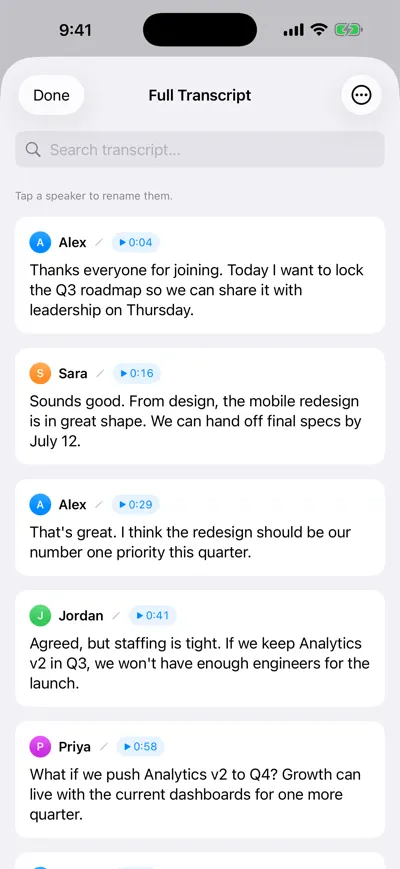
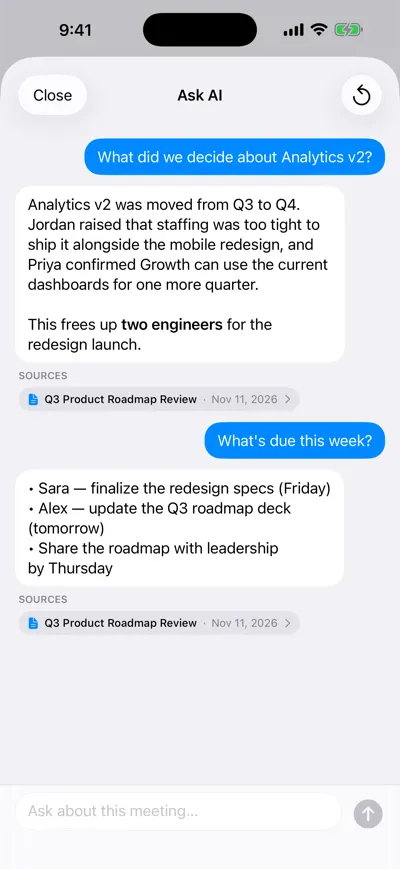
Recording the meeting helps here. With AI Note Taker, place an iPhone on the table or record in the browser for a remote session (nothing joins the call as a bot). The speaker-labeled transcript keeps the explanation behind each idea and who suggested it, and you can ask the transcript questions such as “Which ideas did Sam mention about support?” or “What test did we agree for the sample project?” to fill in the capture sheet. Silent brainwriting obviously produces no audio, so the photos stay essential.
Who suggested what
Ask the transcript to fill gaps
Brainstorm checklist
- One “How might we” question, neither too broad nor already answered.
- Brief with facts and constraints sent 24 hours ahead.
- 4–8 participants, mixed roles, including someone new to the problem.
- A facilitator who does not pitch ideas.
- Silent generation before any discussion.
- A clear switch from diverge to converge, said out loud.
- Decider votes last.
- Top 3 ideas each have a test, a success signal, an owner and a date.
- Capture sheet filled in and shared the same day.
If the brainstorm is part of a bigger kickoff, pair it with the project kickoff meeting template. If you are brainstorming improvements to how the team works, a retrospective is the better format. Track the resulting tests like any other meeting action items.
Frequently asked questions
Let AI take the notes for you
AI Note Taker records and transcribes your meetings, then writes the summary, decisions and action items. Free to start, no install needed.