Templates
Project Kickoff Meeting Template: Agenda, Deck Outline and RACI
Updated · 9 min read
A project kickoff meeting template covers four questions in order: why the project exists, what is in and out of scope, who owns and approves each piece of work, and how the team will work until the first milestone. This page gives you a 90-minute kickoff agenda (plus a 45-minute internal version), a 10-slide kickoff deck outline, a RACI chart template, a filled-in example from a website redesign, and the notes template to send afterwards.
What a project kickoff meeting should settle
By the end of the kickoff, every person in the room should be able to answer these questions the same way. If they can’t, the disagreement will surface later, usually as rework or a missed date.
| Question | Answered by | Evidence it is settled |
|---|---|---|
| Why are we doing this, and why now? | Sponsor | One-sentence problem statement nobody disputes |
| How will we know it worked? | Project lead + sponsor | 2–3 success metrics with a target and a date |
| What is in and out of scope? | Project lead | Written in/out list, read aloud and agreed |
| Who decides, who does the work, who is informed? | Project lead | RACI chart with one A per deliverable |
| When is the first milestone? | Project lead + team | A date the people doing the work agreed to |
| How do we work together? | Team | Cadence, channel, file location, escalation path |
| What could go wrong? | Everyone | Top 3–5 risks, each with an owner |
The general meeting agenda template guide includes a short 60-minute kickoff agenda. Use that for small internal projects; the templates below are for projects with several teams, an outside client or a budget someone has to sign off.
Project kickoff meeting agenda (90 minutes)
Ninety minutes sounds long, but for a project that will run for months it is cheap. The break matters: the second half is where scope and roles get argued, and people need to be fresh for it.
[PROJECT NAME] — KICKOFF
[Date], [Time]–[Time], [Room / link]
Outcome: agreement on goals, scope, roles and the first milestone.
Pre-read: kickoff deck (15 min) — [link], sent [date]
Note-taker: [Name]   Timekeeper: [Name]

0:00  Welcome and introductions: name, role, what you need from this
      project (10 min) — [Project lead]
0:10  Why this project, why now (8 min) — [Sponsor]
0:18  Goals and success metrics; questions (12 min) — [Project lead]
0:30  Scope: in, out, and assumptions; questions (15 min) — [Project lead]
0:45  Break (5 min)
0:50  Roles and RACI: walk through, fix gaps (15 min) — [Project lead]
1:05  Milestones and the first deliverable (10 min) — [Project lead]
1:15  Ways of working: cadence, tools, approvals, escalation (5 min)
1:20  Risks and open questions: silent writing, then discuss (7 min) — All
1:27  Read back decisions, action items, next meeting date (3 min)
Shorter version: internal kickoff (45 minutes)
[PROJECT NAME] — INTERNAL KICKOFF — [Date], 45 min
Outcome: same picture of goal, scope and owners before work starts.
Pre-read: one-page brief — [link]

1. The problem and the goal in one sentence (5 min) — [Lead]
2. Success metric and target date (5 min) — [Lead]
3. In scope / out of scope: read aloud, object now (10 min) — All
4. Owners: who is Accountable for each deliverable? (10 min) — [Lead]
5. First milestone and check-in cadence (7 min) — [Lead]
6. Top risks, one per person (5 min) — All
7. Read back actions (3 min) — [Note-taker]
Kickoff deck outline: 10 slides
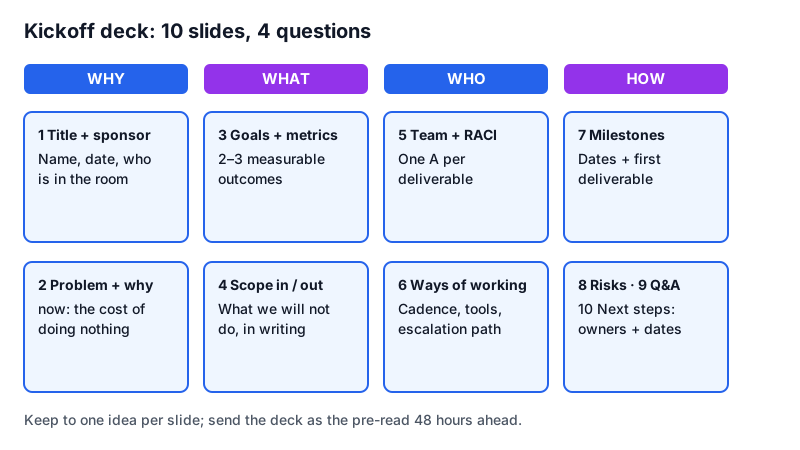
SLIDE 1 — TITLE
[Project name], kickoff, [date]. Sponsor: [Name]. Project lead: [Name].

SLIDE 2 — PROBLEM AND WHY NOW
The problem in one sentence. What it costs today ([hours / $ / customers]).
What happens if we do nothing for another [6 months].

SLIDE 3 — GOALS AND SUCCESS METRICS
Goal: [outcome, not output].
Metric 1: [from X to Y by date]   Metric 2: [ ]   Metric 3: [ ]

SLIDE 4 — SCOPE
In scope: [list]   Out of scope: [list]   Assumptions: [list]

SLIDE 5 — TEAM AND RACI
Names and roles; RACI table for the main deliverables.

SLIDE 6 — WAYS OF WORKING
Meetings: [weekly sync, day/time]. Channel: [ ]. Files: [ ].
Approvals: [who signs off what, turnaround]. Escalation: [path].

SLIDE 7 — MILESTONES
[Milestone] — [date] — [owner]   (4–6 milestones max; first one bold)

SLIDE 8 — RISKS
[Risk] — likelihood [H/M/L] — impact [H/M/L] — owner — mitigation

SLIDE 9 — OPEN QUESTIONS / Q&A
Questions we already know we can't answer yet, and who will.

SLIDE 10 — NEXT STEPS
[Action] — [Owner] — [Date]. Next meeting: [date]. Notes from: [Name].
Keep one idea per slide and resist adding a detailed Gantt chart. The deck is a conversation starter; the project plan lives elsewhere. If a slide takes more than two minutes to present, it belongs in the pre-read, not the meeting.
RACI chart template for the kickoff
RACI stands for Responsible (does the work), Accountable (owns the outcome and signs off, exactly one person), Consulted (gives input before the work is done, two-way) and Informed (told after, one-way). Draft it before the kickoff and fix it live. The gaps you find in the room are the point.
| Deliverable | Sponsor (CMO) | Project lead | Design lead | Dev lead | Legal | Sales |
|---|---|---|---|---|---|---|
| Sitemap and page list | I | A | R | C | C | |
| Visual design | C | I | A / R | C | I | |
| Copy for key pages | C | A | C | C | R | |
| Build and QA | I | C | C | A / R | ||
| Privacy and cookie text | I | C | C | A / R | ||
| Go-live decision | A | R | C | C | C | I |
RACI — [Project]   R = does the work, A = owns + signs off (one per row),
                   C = consulted before, I = informed after

| Deliverable        | [Name/role] | [Name/role] | [Name/role] | [Name/role] |
|--------------------|-------------|-------------|-------------|-------------|
| [Deliverable 1]    |             |             |             |             |
| [Deliverable 2]    |             |             |             |             |
| [Deliverable 3]    |             |             |             |             |
| [Go-live / launch] |             |             |             |             |

Checks before the kickoff:
[ ] Every row has exactly one A
[ ] Every row has at least one R
[ ] Nobody is C on everything (that slows every decision)
[ ] The sponsor is A on the final go / no-go
Filled-in example: kickoff notes
This is what the kickoff notes look like for a mid-size website redesign, sent the same afternoon. Decisions and open questions are separated, so nobody mistakes a discussion for an agreement.
WEBSITE REDESIGN — KICKOFF NOTES — Nov 12, 2026 (90 min)
Present: Hana (CMO, sponsor), Leo (project lead), Ines (design),
Marek (dev), Ruth (legal, first 45 min), Sam (sales)
Notes: Leo

WHY: demo requests from the site fell 22% year on year; the
pricing page is the top exit page.

GOALS
1. Demo requests from organic visitors +30% by end of Q2 2027
2. Pricing page exit rate below 45% (today 61%)

SCOPE — agreed
In: home, pricing, product pages (4), demo form, new design system
Out: blog migration, localisation, customer portal
Assumption: current CMS stays

DECISIONS
- Leo is Accountable for the sitemap and copy; Hana owns go-live.
- Design reviews: Tuesdays, Hana approves within 2 working days.
- Sales writes first-draft copy for pricing; Leo edits.

OPEN QUESTIONS
- Do we keep the free trial button? — Hana to decide by Nov 19
- Cookie banner vendor change needed? — Ruth to check by Nov 21

MILESTONES
- Sitemap signed off — Nov 21 — Leo
- Pricing page design approved — Dec 9 — Ines
- Build complete — Feb 13 — Marek
- Go live — Mar 3 — Hana

RISKS
- Sales copy slips in December (holidays) — Sam — drafts due Dec 5
- Design system takes longer than pages — Ines — weekly check

NEXT: weekly sync Tuesdays 10:00; first one Nov 18.
Kickoff meeting notes template
[PROJECT] — KICKOFF NOTES — [Date]
Present: [Names, roles]   Absent: [Names]   Notes: [Name]
Recording / deck: [links]

WHY: [problem, one sentence]
GOALS / METRICS: [metric — target — date]
SCOPE: In: [ ]   Out: [ ]   Assumptions: [ ]

DECISIONS
- [Decision] — agreed by [Name]

OPEN QUESTIONS
- [Question] — [Owner] — [Answer by date]

RACI: [link, or "unchanged from deck"]
MILESTONES: [Milestone] — [Date] — [Owner]
RISKS: [Risk] — [Owner] — [Mitigation]

ACTION ITEMS
- [Action] — [Owner] — [Due]

NEXT MEETING: [day, time, link]
Before and after the kickoff
Kickoff preparation
- The sponsor has confirmed the goal and the budget before the invite goes out.
- The deck went out 48 hours ahead with a request to send questions in advance.
- Draft RACI is in the deck, with gaps marked rather than guessed.
- The right decision makers are invited; people who only need the outcome get the notes.
- Someone other than the project lead is taking notes or the meeting is recorded.
- The first recurring check-in is already in calendars, for example a weekly team meeting.
The project lead usually runs the kickoff, which makes it hard to take good notes at the same time. Ask for consent and record it, then write the notes from the recording. The scope and RACI discussion in particular is worth having word for word, because those are the parts people remember differently a month later.
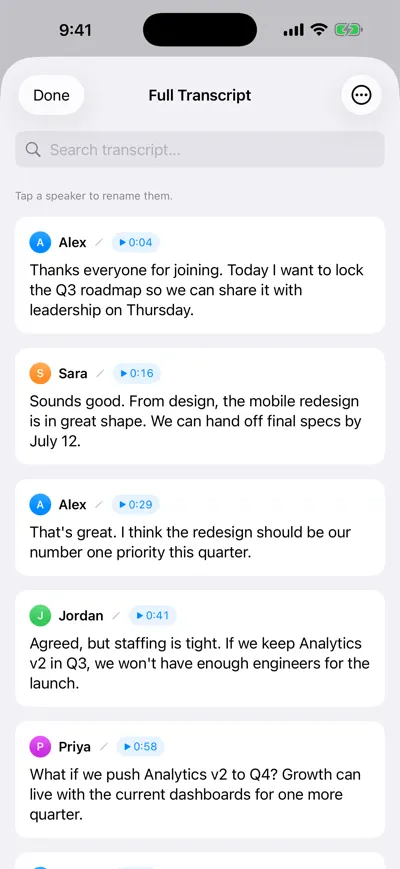
Who agreed to what, word for word
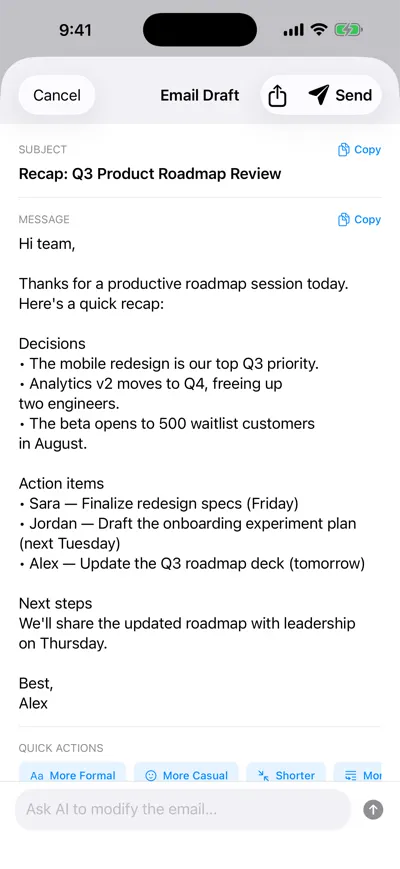
Draft the kickoff notes email
Frequently asked questions
Let AI take the notes for you
AI Note Taker records and transcribes your meetings, then writes the summary, decisions and action items. Free to start, no install needed.