Templates
Sales Call Notes Template: What to Capture (4 Free Templates)
Updated · 10 min read
A good sales call notes template captures the prospect’s own words on their pain, its business impact, how they solve it today, who decides and how, budget and timing, objections, and one next step with a date. Below are four copy-paste templates — discovery, demo, negotiation and a CRM-ready summary — plus a MEDDIC question table, a filled-in example and a post-call checklist.
What to capture on every sales call
Whether you are a founder, an AE or a consultant, the notes that matter are the same. Your pitch and the small talk can go.
- Pain, in their words. “Our reps spend Fridays rebuilding the forecast in Excel” is useful. “Reporting issues” is not.
- Impact. What the pain costs in hours, money, risk or missed targets. Ask for a number.
- Current solution. What they use today, what they like about it, and why it is not enough. This is your real competitor — often a spreadsheet or “do nothing”.
- Decision process and people. Who signs, who influences, who can block, and what steps a purchase goes through (security review, legal, procurement).
- Budget and timing. Whether money exists, roughly how much, and the event that makes this urgent — a renewal date, a hire, a board meeting.
- Objections and concerns. Every “but…” and “we tried something like this before”. Write down how you answered and whether it landed.
- Next step with a date. Not “follow up next week”. “Demo for Priya and her two team leads, Tuesday Nov 18 at 2pm, invite sent.”
Use MEDDIC to find what you are missing
MEDDIC is a well-known B2B qualification framework: Metrics, Economic buyer, Decision criteria, Decision process, Identify pain and Champion. Don’t run it as a script. After each call, the empty boxes become your questions for the next one. For the questions to ask on a first call, stage by stage, see the discovery call template.
| Element | Questions to ask | What to write down |
|---|---|---|
| Metrics | “How do you measure this today?” “What would a good result look like in numbers?” | The baseline and target in their units, e.g. “Close rate 18%, want 25% by Q3.” |
| Economic buyer | “Who owns the budget for this?” “Who has to say yes for this to happen?” | Name, title, whether you have met them, and what they care about. |
| Decision criteria | “How will you compare options?” “What would make you rule a vendor out?” | Their must-haves and deal-breakers, ranked if they said so. |
| Decision process | “Walk me through how you bought the last tool like this.” “Who else gets involved after this call?” | The steps in order (trial, security review, legal, procurement) with rough dates. |
| Identify pain | “What happens if you don’t fix this?” “Why now, and not last year?” | The pain as a direct quote, plus the trigger event that makes it urgent. |
| Champion | “Who else wants this fixed?” “How can I help you make the case internally?” | The person selling for you when you are not in the room, and what they need from you. |
Four sales call notes templates
Copy the one that matches the call. Fill the header beforehand and the rest right after.
DISCOVERY CALL — [Company], [Date]
Attendees: [Name, title] / [Name, title]   Our side: [Name]
Source: [Inbound / outbound / referral from ___]

PAIN (their words)
- "[Exact quote]"
- "[Exact quote]"

IMPACT
- Cost today: [hours / $ / risk / missed target]
- Trigger / why now: [event + date]

CURRENT SOLUTION
- Using: [tool, spreadsheet, agency, nothing]
- Works well: [ ]
- Falls short: [ ]

DECISION
- Economic buyer: [Name, title] — met? [Y/N]
- Others involved: [Names, roles]
- Process: [steps] — target decision date: [Date]

BUDGET & TIMING
- Budget: [exists? range? from which line?]
- Timeline: [go-live date and why]

OBJECTIONS / CONCERNS
- [Objection] → [How I answered] → [Landed? Y/N]

FIT: [Strong / Medium / Weak] because [one line]

NEXT STEP: [What] with [Who] on [Date, time] — invite sent? [Y/N]
DEMO CALL — [Company], [Date]
Attendees: [Names, titles]   New since discovery: [Names]

RECAP CONFIRMED AT START
- Pain we're solving: [one line]  Confirmed? [Y/N, any changes]

WHAT WE SHOWED → REACTION
- [Feature / workflow] → "[Their reaction, quoted]"
- [Feature / workflow] → "[Their reaction, quoted]"

QUESTIONS THEY ASKED
- [Question] → [Answer given / to follow up]

GAPS & OBJECTIONS
- [Missing feature or concern] → [Response] → [Deal-breaker? Y/N]

BUYING SIGNALS
- [e.g. asked about pricing, onboarding time, contract length]

DECISION CRITERIA (updated)
- Must-haves: [ ]
- Nice-to-haves: [ ]

NEXT STEP: [Trial / proposal / security review] — [Owner] — [Date]
NEGOTIATION CALL — [Company], [Date]
Attendees: [Names, titles]   Economic buyer present? [Y/N]

WHERE WE ARE
- Proposal sent: [Date, version]   Price quoted: [$]

OPEN ISSUES
| Issue          | Their position       | Our position   | Status   |
|----------------|----------------------|----------------|----------|
| Price          | [ ]                  | [ ]            | [Open]   |
| Term / payment | [ ]                  | [ ]            | [ ]      |
| Legal / security | [ ]                | [ ]            | [ ]      |

CONCESSIONS
- We offered: [ ] in exchange for: [ ]
- They asked for (not agreed): [ ]

REMAINING STEPS TO SIGNATURE
1. [Step] — [Owner] — [Date]
2. [Step] — [Owner] — [Date]

RISKS: [competitor, budget freeze, champion leaving, timing]

TARGET CLOSE DATE: [Date]   Confidence: [%]
NEXT STEP: [What] — [Who] — [Date]
Call type: [Discovery / Demo / Negotiation]
Date: [YYYY-MM-DD]
Contacts: [Name, title; Name, title]
Stage: [e.g. Qualified / Demo done / Proposal / Negotiation]
Pain: [one line, in their words]
Impact: [number]
Current solution: [ ]
Economic buyer: [Name] (met: Y/N)
Champion: [Name]
Decision process: [steps + dates]
Budget: [range or unknown]
Timeline: [target go-live]
Competitors: [ ]
Objections: [short list]
Next step: [What] — [Date]
Deal value: [$]   Close date: [Date]
Notes / recording link: [link]
Filled-in example: a discovery call
Here is the discovery template after a 30-minute call. The notes are short, specific and mostly quotes.
DISCOVERY CALL — Northwind Logistics, Nov 11, 2026
Attendees: Priya Shah, VP Sales Ops / Daniel Ruiz, RevOps Analyst
Our side: Maya Chen
Source: Inbound (pricing page)

PAIN (their words)
- "Every Friday, two of my analysts rebuild the forecast by hand."
- "By the time it reaches the CRO it's already out of date."

IMPACT
- ~12 analyst hours/week; forecast missed by 14% last quarter
- Trigger: new CRO starts Jan 6 and wants a weekly forecast review

CURRENT SOLUTION
- Using: CRM exports + a 40-tab Excel model
- Works well: Daniel knows it inside out
- Falls short: breaks when territories change; no history

DECISION
- Economic buyer: Tom Becker, CFO — not met yet
- Others involved: IT security (review takes ~3 weeks)
- Process: trial → security review → CFO sign-off — decision by Dec 15

BUDGET & TIMING
- Budget: "We set aside money for tooling in Q4" — ~$30–40k/yr
- Timeline: live before Jan 6

OBJECTIONS / CONCERNS
- "We tried a forecasting tool in 2024 and nobody used it."
  → Showed rep-free setup; Priya: "That's different." Landed: Y
- Data security → sent SOC 2 report link. Landed: pending IT

FIT: Strong — urgent trigger, clear owner, budget exists

NEXT STEP: Demo for Priya, Daniel + 2 team leads, Tue Nov 18, 2pm
— invite sent. Ask Priya to bring Tom for the last 15 minutes.
How to take notes on a sales call without losing the conversation
Prepare the header before the call
Fill in company, attendees, what you already know and the three questions you most need answered.
Ask for consent to record
Something like: “Mind if I record so I can focus on you instead of my notes? I’ll only use it for our follow-up.” Most people say yes. Recording laws differ by country and state — some require everyone’s consent — so check the rules that apply to you. This is not legal advice.
Listen, and jot only anchors
If you are typing while they talk, you miss the follow-up question you should ask. Note a single word (“Friday rebuild”, “CFO”) and get the detail from the recording.
Capture exact quotes
When the prospect describes their problem in a vivid way, write it word for word. Those lines go straight into your follow-up email, your proposal and your champion’s internal pitch — buyers trust their own words more than yours.
Confirm the next step out loud
In the last five minutes, summarize what you heard and agree on one next step with a date. Send the calendar invite before you hang up if you can.
Write the summary within an hour
Fill the template, paste the CRM summary and send the follow-up email. After an hour you start remembering the call you wanted to have, not the one you had.
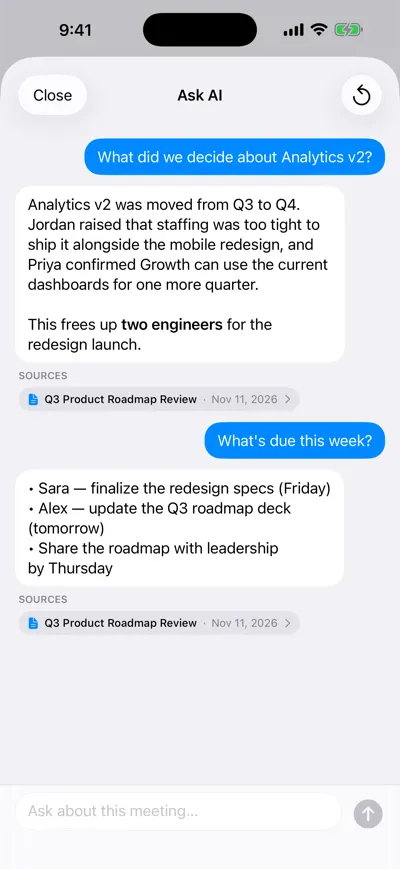
Ask questions about one call
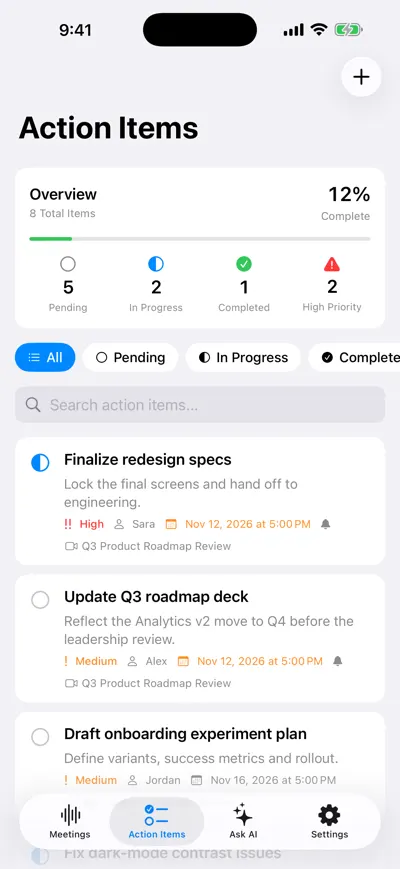
Next steps with dates and reminders
Turn your notes into a follow-up email
Your notes are only half the job — the prospect never sees them. The follow-up email is where the notes earn their keep: open with what you heard (in their words), connect it to how you help, and restate the next step with its date. The follow-up email guide has a sales and discovery template built for exactly this, and the meeting recap email guide covers subject lines and timing.
If you recorded the call, AI Note Taker can draft the recap from the meeting’s summary and action items; you adjust the tone, review it and copy it into your email client.
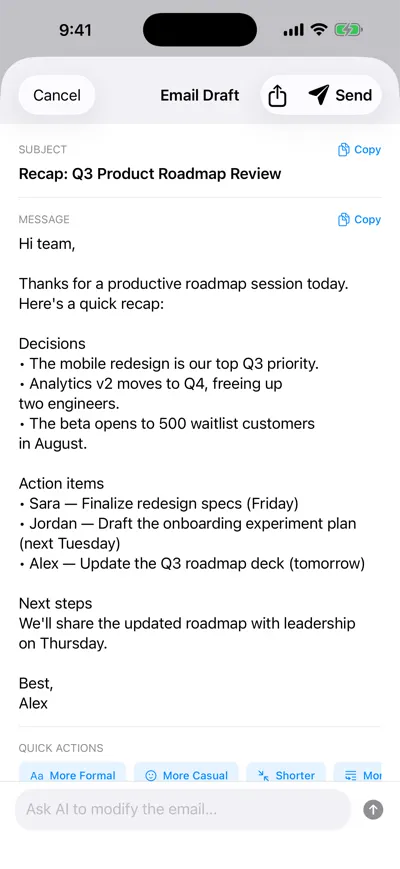
AI-drafted recap email
Post-call checklist
Within an hour of hanging up
- Template filled: pain, impact, current solution, decision, budget, timing, objections
- At least two exact quotes from the prospect saved
- MEDDIC gaps listed as questions for the next call
- Next step has a date, an owner and a calendar invite
- Follow-up email sent with what you heard and the next step
- CRM updated with the summary fields, stage, deal value and close date
- Any promised material (case study, pricing, security docs) sent or scheduled
- Recording and transcript saved and linked from the CRM record
For meetings that are not sales calls, see how to take meeting notes.
Frequently asked questions
Let AI take the notes for you
AI Note Taker records and transcribes your meetings, then writes the summary, decisions and action items. Free to start, no install needed.