Templates
Discovery Call Template: Questions by Stage, Script and Notes
Updated · 10 min read
A discovery call template is a call plan, not a script: six stages (context, situation, problem and impact, past attempts, decision and timing, next step), a few open questions for each, and a notes sheet laid out in the same order so you can see what you still haven’t learned. Below you’ll find the 30-minute plan with timings, 24 questions grouped by stage, a notes template, a filled-in example, and a variant for founders and product teams doing customer discovery rather than selling.
The discovery call template at a glance
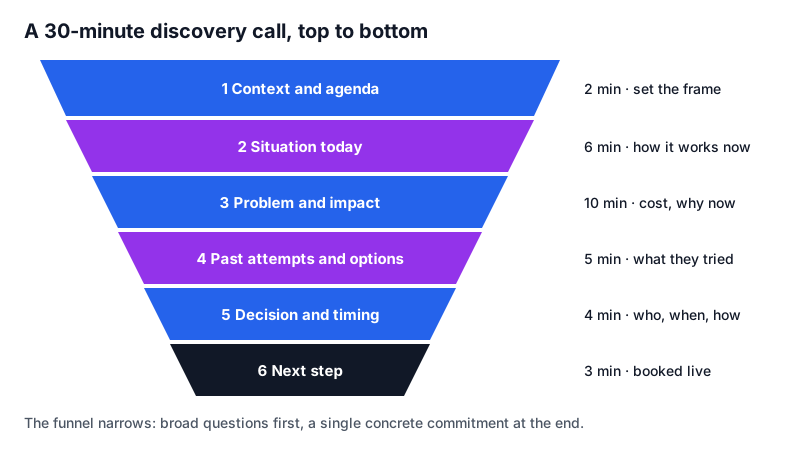
| Stage | Minutes | What you need to leave with |
|---|---|---|
| 1. Context and agenda | 0–2 | Agreement on the call’s purpose and length; permission to ask questions (and to record, if you do) |
| 2. Situation today | 2–8 | How the work is done now, by whom, with which tools |
| 3. Problem and impact | 8–18 | The problem in their words, what it costs, and why it matters now |
| 4. Past attempts and options | 18–23 | What they’ve tried, what they’re comparing, what “good” looks like |
| 5. Decision and timing | 23–27 | Who else is involved, how they decide, any deadline |
| 6. Next step | 27–30 | A specific meeting in the calendar, or a clear no |
The order is deliberate. People answer questions about budget and decision makers far more openly after they have spent ten minutes describing a problem that clearly matters to them. Ask about budget in minute three and you get a guarded answer.
Discovery call script: the opening and the close
You don’t need a script for the middle of the call; you need good questions and the discipline to follow up. The opening and the close are worth scripting, because they are where calls most often drift.
OPENING (2 min)
"Thanks for making time, [Name]. We have 30 minutes, does that
still work? My goal today is to understand how [area] works for
you now and whether there's a problem worth solving. I'll ask a
lot of questions; at the end, if it looks like we can help, we'll
agree on a next step, and if not, I'll say so. Sound OK?"
[If recording:] "Mind if I record so I can listen instead of typing?"

BRIDGE INTO THE PROBLEM
"You mentioned [trigger from their form / email]. What's going on
there?"

SUMMARY BEFORE THE CLOSE (1 min)
"Let me check I've got this right: today you [situation]. The
problem is [problem in their words], which costs you [impact].
It matters now because [trigger]. [Name] and [Name] would be
involved in deciding, ideally by [date]. Did I miss anything?"

CLOSE (2 min)
Fit:     "Based on that, I think it's worth showing you [specific
          thing] with [people]. How does [day] at [time] look?"
No fit:  "Honestly, I don't think we're the right fit for [reason].
          [Alternative] might be. Can I send you a pointer?"
Discovery call questions by stage
Pick two or three per stage based on what you already know from research. Follow-up questions (“Tell me more”, “What happened next?”, “Why does that matter?”) do more work than any question on this list.
Situation today
- Walk me through how [process] works today, from start to finish.
- Who is involved, and who owns it?
- Which tools or spreadsheets do you use for it?
- How often does this happen: daily, weekly, per project?
- What does a normal week look like for the person doing it?
- What changed recently in your team or company that affects this?
Problem and impact
- What’s the hardest part of [process] right now?
- Can you tell me about the last time that went wrong?
- What did it cost you: time, money, customers, stress?
- How do you measure it today? What’s the number?
- Who else feels this problem, and how?
- What happens if nothing changes in the next six months?
- Why is this a priority now rather than last year?
- Where does it rank against the other things on your plate?
Past attempts and options
- What have you tried so far? What happened?
- Why did that approach stop working (or never start)?
- Are you looking at other options right now?
- If you could fix this perfectly, what would be different?
- What would make a solution a non-starter for you?
Decision and timing
- Apart from you, who would be involved in a decision like this?
- How did your team make the last decision about a tool or vendor like this?
- Is there a date or event this needs to be solved by?
- Is there a budget set aside, or would one need to be created?
- What could get in the way, even if everyone likes the solution?
For a structured way to check what you’ve missed after the call (economic buyer, decision criteria, champion and so on), the sales call notes template walks through MEDDIC and BANT and has separate demo and negotiation notes.
Discovery call notes template
The notes sheet follows the same six stages as the call, with space for evidence: quotes and numbers rather than your interpretation. Empty sections at the end of the call tell you exactly what to ask next time.
DISCOVERY CALL — [Company / person] — [Date] — [Length]
With: [Name, title]   Me: [Name]   How they found us: [ ]
Research before the call: [2–3 facts: size, recent news, role]

1. CONTEXT
   Agreed purpose: [ ]   Recording: [Y / N]

2. SITUATION TODAY
   Process: [ ]
   Owner / people involved: [ ]
   Tools: [ ]   Frequency / volume: [ ]

3. PROBLEM AND IMPACT
   Problem, in their words: "[quote]"
   Last time it went wrong: [story]
   Impact: [number: hours, $, %, customers]
   Why now: [trigger + date]
   Priority vs other work: [High / Medium / Low, their words]

4. PAST ATTEMPTS AND OPTIONS
   Tried: [ ] → result: [ ]
   Comparing: [ ]
   Must-haves: [ ]   Deal-breakers: [ ]

5. DECISION AND TIMING
   Others involved: [Name, role, their concern]
   Process: [ ]   Deadline: [ ]   Budget: [ ]

6. NEXT STEP
   [What] — [Who attends] — [Date, time] — invite sent [Y/N]
   or: Not a fit because [ ]

GAPS TO FILL NEXT CALL: [ ]
MY READ: [Strong / Medium / Weak] — [one line why]
Filled-in example: a discovery call for an HR software vendor
A 30-minute inbound call between an account executive at a scheduling software company and the operations manager of a chain of physiotherapy clinics. Notice that stage 5 is still thin; the gaps line is where the next call starts.
DISCOVERY CALL — Coastline Physio — Nov 12, 2026 — 32 min
With: Aisha Karim, Operations Manager   Me: Daniel
How they found us: webinar on shift swaps (Oct 29)
Research: 9 clinics, ~140 staff, opened 2 clinics this year

1. CONTEXT
   Agreed purpose: see if shift scheduling is worth fixing. Recording: Y

2. SITUATION TODAY
   Process: each clinic manager builds a weekly rota in Excel and
   emails it on Thursday; swaps happen in a WhatsApp group.
   Owner: 9 clinic managers; Aisha consolidates for payroll.
   Tools: Excel, WhatsApp, payroll system   Volume: ~60 swaps/week

3. PROBLEM AND IMPACT
   "Payroll is wrong every single month because swaps never make
   it back into the spreadsheet."
   Last time: October, 14 staff paid for shifts they swapped away;
   2 days to fix, one formal complaint.
   Impact: ~3 manager-hours/week per clinic (27 h/week total);
   payroll corrections ~1.5 days/month for Aisha.
   Why now: two new clinics in 2026; a third opens in March 2027.
   Priority: "Top three for me this quarter."

4. PAST ATTEMPTS AND OPTIONS
   Tried: shared Google Sheet (2025) → managers kept local copies.
   Comparing: the add-on module from their payroll provider.
   Must-haves: phone app for staff, export to payroll.
   Deal-breaker: anything that needs IT; they don't have IT staff.

5. DECISION AND TIMING
   Others: Owen (MD) signs; 2 clinic managers would trial it.
   Process: trial in 2 clinics, then Owen decides. Deadline: before
   the March opening. Budget: "We'd need to see the price first."

6. NEXT STEP
   Demo with Aisha + 2 clinic managers — Thu Nov 20, 11:00 —
   invite sent Y. Aisha will ask Owen to join the last 10 minutes.

GAPS TO FILL NEXT CALL: budget range; how Owen judged the last
purchase; payroll provider's add-on price.
MY READ: Strong — painful, measured problem with a fixed deadline.
Customer discovery version for founders and product teams
Customer discovery interviews use the same funnel without the sales stages. You are not qualifying a buyer; you are testing whether a problem is real, frequent and painful enough that people already spend time or money on it. The biggest difference is that you don’t mention your idea until the end, if at all, because people are polite about ideas and honest about their past.
| Sales discovery call | Customer discovery interview | |
|---|---|---|
| Goal | Qualify and advance a deal | Validate (or kill) a problem hypothesis |
| Who talks about the product | You, briefly, at the end if there’s a fit | Nobody, ideally |
| Key evidence | Impact, trigger, decision process | Past behaviour: what they did, spent, tried |
| Ends with | A booked next meeting | Referrals to others with the same problem |
| Notes compared across | One account over several calls | Many interviews, looking for patterns |
CUSTOMER DISCOVERY — Interview #[n] — [Date]
Person: [role, company type, size]   Segment: [ ]
Hypothesis being tested: "[Role] struggles with [problem] at least
[frequency] and currently [workaround]."

WARM-UP (3 min)
- Tell me about your role. What does a typical week look like?

LAST TIME IT HAPPENED (12 min)
- Tell me about the last time you had to [job].
- What did you do first? Then what?
- What was the hardest part? Why?
- How long did it take? Who else was involved?

WORKAROUNDS AND SPEND (8 min)
- What have you tried to make this easier?
- Have you paid for anything to solve it? What, how much?
- What did you stop using, and why?

PRIORITY (4 min)
- If you could fix one thing about [area], what would it be?
- Where does this rank against your other problems?

CLOSE (3 min)
- Who else should I talk to about this?
- Can I follow up if I have another question?

NOTES
Quotes: "[ ]"
Evidence for hypothesis: [ ]
Evidence against: [ ]
Surprises: [ ]
Verdict: [Supports / Weakens / Unclear]
After the discovery call
Within an hour of the call
- Fill any blank stage in the notes from memory or the recording, and list the gaps.
- Check the quotes are exact; paraphrased pain is easy to exaggerate.
- Send a short follow-up that restates the problem in their words and confirms the next step.
- Log the call in your CRM or interview tracker with the stage and the date of the next step.
- For customer discovery: tag the interview as supporting or weakening the hypothesis before you forget.
For the follow-up itself, see the follow-up email after a meeting guide. If you run discovery as part of a sales team, our page for sales teams shows how recorded calls fit into that workflow.
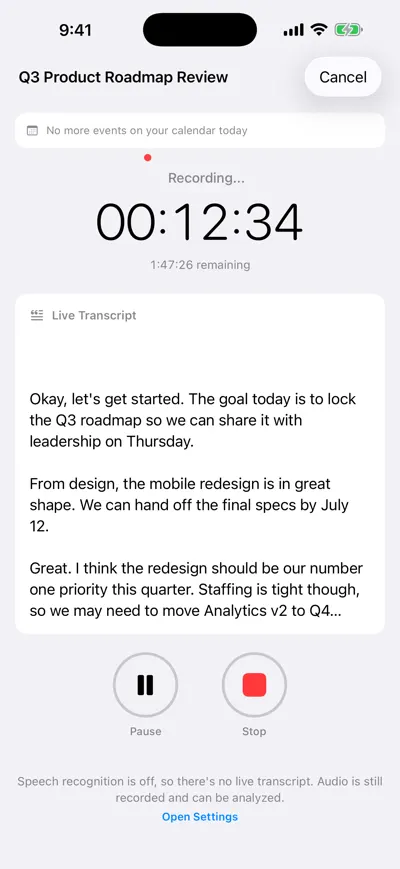
Record and listen
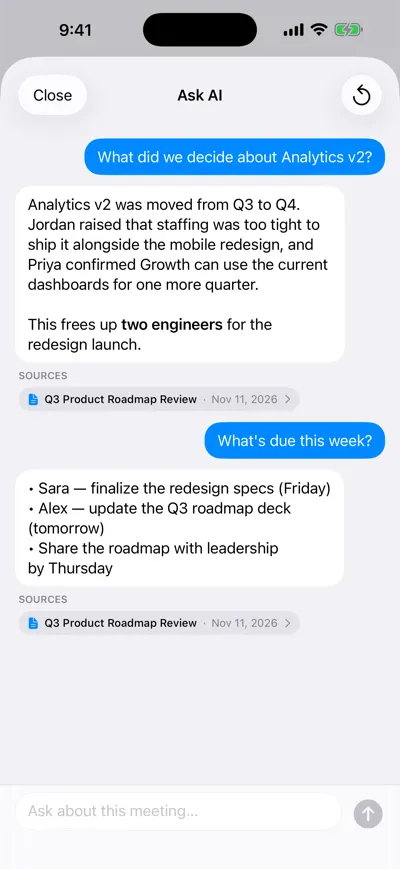
Pull exact quotes afterwards
Frequently asked questions
Let AI take the notes for you
AI Note Taker records and transcribes your meetings, then writes the summary, decisions and action items. Free to start, no install needed.