Templates
Interview Notes Template: For Hiring and User Research
Updated · 10 min read
A good interview notes template gives you fixed slots for evidence: what the person actually said or did, written down close to their words, sorted under the questions or competencies you planned in advance. Hiring interviews and user research interviews need different versions, so this guide covers both — a scorecard, STAR notes and debrief summary for hiring, and a notes sheet plus synthesis grid for research.
What good interview notes have in common
Interview notes have one job: let someone who wasn’t in the room — including you, two weeks later — see what was actually said. Three habits apply to both audiences:
- Prepare the structure first. Put your questions or competencies in the template before the interview, so you’re filling slots instead of writing an essay.
- Capture close to verbatim. Shorthand is fine (“→” for “led to”, initials for names), but keep the person’s key words. Paraphrase drifts toward what you expected to hear.
- Clean up within an hour. Fill gaps while memory is fresh. After a day, you’ll remember your conclusion, not the evidence for it.
| Bad note | Good note | Why it’s better |
|---|---|---|
| “Great communicator.” | “Explained the migration plan to me in 3 steps without jargon; checked I followed before moving on.” | Describes behavior anyone can evaluate. |
| “Weak on leadership.” | “Asked about leading a project: described tasks she was assigned, not decisions she made. No example of influencing others.” | Shows what was missing, not just a verdict. |
| “Seems young, probably not ready for a lead role.” | “Has led one team of 3 for 8 months; no example yet of managing a low performer.” | Removes an age reference (legal risk) and states the actual gap. |
| “Users hate onboarding.” | P4: “I gave up on the setup wizard after step 3 and asked my coworker.” (Observed: skipped two tooltips.) | Quote plus observation; the conclusion comes later, in synthesis. |
Part A: Interview notes for hiring
Hiring notes feed a decision about someone’s career and may be reviewed later. Structured notes make that decision fairer and easier to defend: each interviewer covers assigned competencies, asks the same core questions of every candidate, and records evidence against a rating scale agreed in advance.
Structured interview scorecard notes
Use one copy per candidate per interview. List only the competencies you were assigned — if three interviewers all assess “communication,” nobody assesses “ownership.”
INTERVIEW SCORECARD
Candidate: [Name]            Role: [Job title]
Interviewer: [Your name]     Date: [Date]     Stage: [Phone screen / Onsite / Final]

Rating scale: 1 = No evidence  2 = Some evidence, gaps  3 = Meets bar  4 = Strong evidence, exceeds bar

COMPETENCY 1: [e.g. Ownership]
Question asked: [e.g. "Tell me about a project that was at risk and what you did."]
Evidence (what they said or did):
-
-
Concerns / missing evidence:
-
Rating: [1-4]

COMPETENCY 2: [e.g. Technical problem solving]
Question asked:
Evidence:
-
Concerns / missing evidence:
-
Rating: [1-4]

COMPETENCY 3: [e.g. Collaboration]
Question asked:
Evidence:
-
Concerns / missing evidence:
-
Rating: [1-4]

Candidate questions for us:
-

OVERALL (write before the debrief)
Recommendation: [Strong no / No / Yes / Strong yes]
Top reason for:
Top reason against:
What the next interviewer should probe:
Behavioral (STAR) interview notes
Behavioral questions (“Tell me about a time…”) work best when you note the answer in STAR order: Situation, Task, Action, Result. If a slot stays empty, that’s your follow-up question. The most common gap is Action — candidates describe what “we” did, so ask “What did you do?”
QUESTION: [e.g. "Tell me about a time you disagreed with your manager."]

S - Situation: [Where, when, what was going on]
   e.g. Q2 2025, payments team, launch date set by VP

T - Task: [What they were responsible for]
   e.g. Owned release readiness; believed date was 3 weeks too early

A - Action: [What THEY did - their verbs, not "we"]
   e.g. Wrote 1-page risk list, proposed phased launch, met VP 1:1

R - Result: [Outcome, ideally with a number]
   e.g. Launched 10% of traffic on date, full rollout 2 weeks later, 0 Sev-1s

Follow-ups asked:
- "What would you do differently?" -> [answer]

Signals: [competency] - [rating] - [one line of evidence]
Keep bias and legal risk out of your notes
Interview notes can be requested in a dispute or audit, and they shape how your colleagues see the candidate. A simple rule: if it isn’t evidence about the job-related criteria, don’t write it. In particular, avoid notes about protected characteristics — in the US these include race, color, religion, sex (including pregnancy), national origin, age, disability and genetic information, and many states and countries add more. That covers comments on accent, appearance, family plans, health, or “culture fit” used as a vague stand-in for “like us.” If a candidate volunteers personal information (“I have two kids”), don’t record it and don’t let it influence your rating.
Write the scorecard before the debrief
Submit your ratings and recommendation before you talk to other interviewers or read their feedback. Once you hear “I loved her,” your memory quietly rewrites itself — and independent scores make real disagreement visible. Then the hiring manager can run the debrief from a summary like this:
DEBRIEF — [Candidate], [Role] — [Date]
Panel: [Names]   Decision owner: [Hiring manager]

Scores (submitted before debrief)
- [Interviewer 1]: [Competency] [1-4], [Competency] [1-4] -> [Recommendation]
- [Interviewer 2]: [Competency] [1-4], [Competency] [1-4] -> [Recommendation]

Where we agree (with evidence):
-
Where we disagree (with evidence from each side):
-
Open questions / unassessed areas:
-
Decision: [Hire / No hire / Another interview on X]
Reasoning (job-related evidence only):
Next step + owner + date:
Should you record hiring interviews?
Usually not without a clear policy. Many companies forbid recording hiring interviews, and those that allow it typically require telling the candidate in advance and getting consent. Consent rules vary by place — some US states require everyone on the call to agree, and data-protection laws such as the GDPR add rules on storing it — so check your company’s policy first (again, not legal advice). Typed notes against a scorecard remain the norm and are enough if you capture evidence as you go.
Part B: User research interview notes
In user research, the goal isn’t a verdict on a person — it’s finding patterns across 5–12 conversations. Your notes need to keep the participant’s exact words and separate what happened from what you think it means, so synthesis is based on data rather than whoever took the most confident notes.
Research interview notes template
RESEARCH INTERVIEW — P[#]
Date: [Date]   Interviewer: [Name]   Note-taker: [Name]
Participant: [Role, company size, segment - no names in shared notes]
Study goal: [e.g. Why do new teams stall during onboarding?]
Recording: [Yes - consent given at start / No]

CONTEXT
- Current tools / workflow:
- How often they do [task]:

NOTES (one row per moment)
[Time] Quote: "..."  | Observed: ...  | My guess: ...  | Tag: ...
04:12  Quote: "I just skip that bit."  | Observed: scrolled past setup video  | My guess: video too long?  | Tag: onboarding

SURPRISES (things that contradict our assumptions)
-

TOP 3 TAKEAWAYS (write within 1 hour)
1.
2.
3.

Follow-ups: [Send recording link / ask for screenshots / intro to colleague]
Interview in pairs when you can: one asks, one notes. Alone, record (with permission) and jot only timestamps and surprises.
Keep the columns honest: a quote is their exact words, an observation is what you saw them do, and an interpretation is your hypothesis to test later. Tag each row with a short theme (onboarding, pricing, trust) — tags are what make synthesis possible.
Recording research interviews
Recording is standard practice in user research, and it frees you to listen instead of type. Ask at the start (“Is it OK if I record so I don’t have to take notes? It’s only shared with the research team”), note the consent in your template, and let people stop the recording at any time. Remove names and company details from anything you share widely. For in-person sessions, see how to transcribe an in-person meeting.
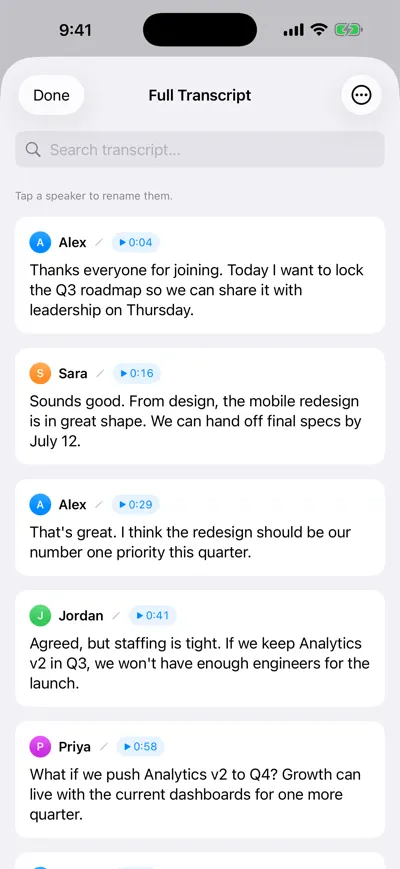
Speaker-labeled transcript with timestamps
Synthesis across interviews
After the last interview, lay all tagged notes side by side. An affinity sheet — one row per theme, one column per participant — shows quickly which problems are widespread and which came from one memorable person.
Pull every tagged quote and observation
Copy rows from every participant’s notes into one sheet, keeping participant ID and timestamp on each row.
Group by theme
Cluster rows under your tags, and rename or merge tags that turn out to be the same thing (“setup” and “onboarding”).
Count participants, not mentions
One person complaining about pricing five times is one data point. Write “4 of 8 participants” in the summary.
Write insights with evidence
Each insight gets a one-line statement, the participant count and two or three supporting quotes.
Decide what to do
Turn each insight into a recommendation or a question for the next round of research, with an owner.
STUDY: [Name]   Interviews: P1-P8   Dates: [Range]

THEME          PARTICIPANTS          COUNT
Onboarding     P1, P3, P4, P6, P8    5/8
Reporting      P2, P5                2/8
Pricing        P2, P7                2/8

INSIGHT 1: [One-sentence finding]
Evidence: 5/8 participants
- P3 (12:40): "..."
- P4 (04:12): "..."
Recommendation: [What to change / test next]   Owner: [Name]

INSIGHT 2:
Evidence:
Recommendation:   Owner:

OPEN QUESTIONS FOR NEXT ROUND
-
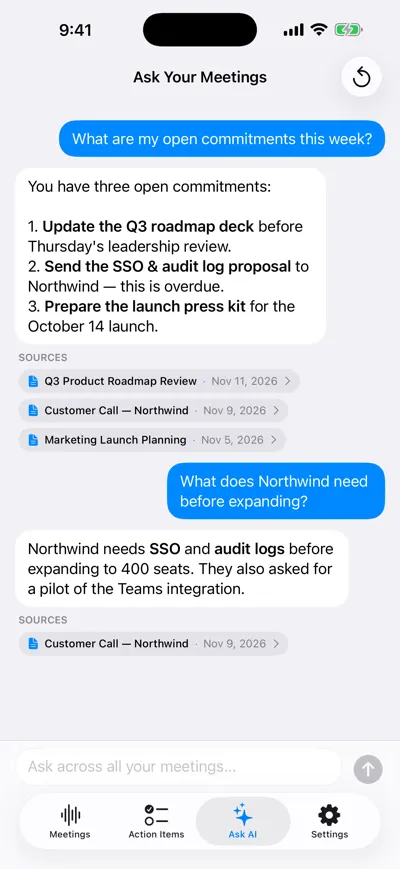
Ask AI across all meetings, with sources
Interview notes checklist
- Template filled in with questions or competencies before the interview
- Consent asked and noted (or no recording, per policy)
- Notes capture quotes and behavior, not adjectives
- Hiring: nothing about protected characteristics or personal life
- Research: quotes, observations and interpretations kept apart, rows tagged
- Notes cleaned up within an hour
- Hiring: scorecard submitted before the debrief
- Research: synthesis counts participants, not mentions
For other meeting types, see our general guide on how to take meeting notes, the one-on-one meeting template, and how AI meeting summaries work.
Frequently asked questions
Let AI take the notes for you
AI Note Taker records and transcribes your meetings, then writes the summary, decisions and action items. Free to start, no install needed.