Legal & privacy
Is It Legal to Record a Meeting or Call? Consent Laws in All 50 States
Updated · 16 min read
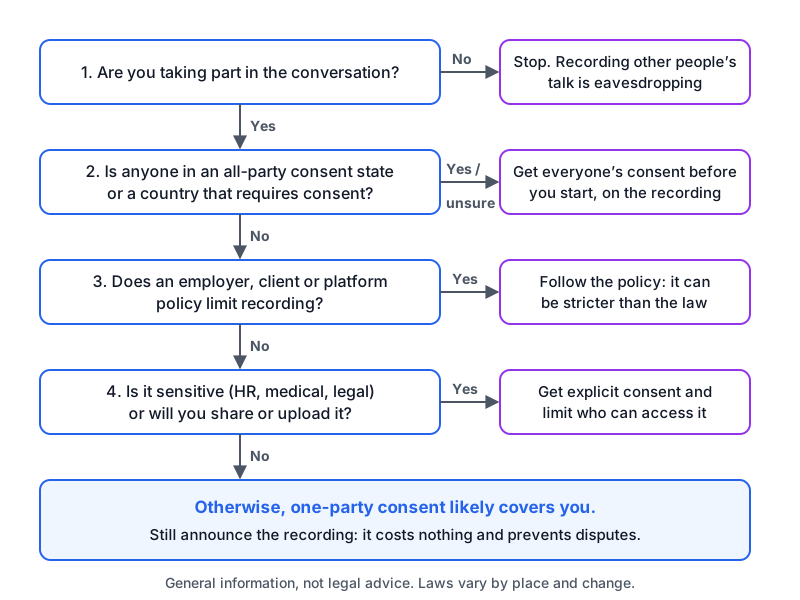
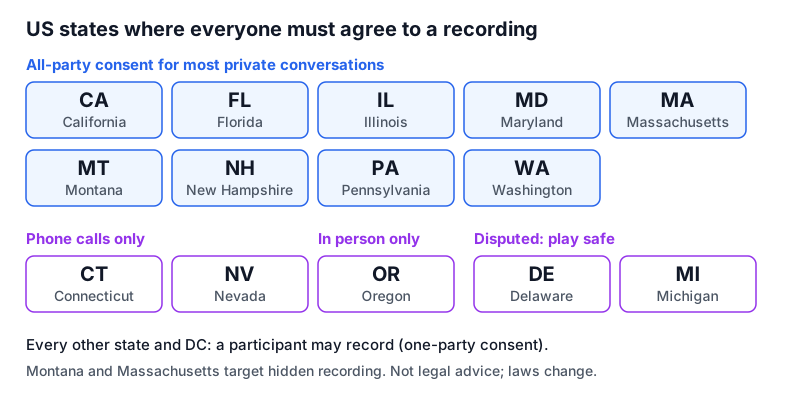
Is it legal to record a meeting? In most of the US, yes, if you are taking part in it: federal law, DC and most states follow one-party consent, so a participant may record without telling anyone. But about a dozen states, including California, Florida, Illinois, Pennsylvania and Washington, require everyone’s consent in most situations, a few split the rule between phone calls and in-person talks, and many countries have their own rules. Because a video meeting can include people in several states at once, the safe habit is simple: tell everyone you’re recording and get a “yes” before you start. Below is a decision flowchart, a table of all 50 states and DC with statutes, and copyable consent scripts.
One-party vs. all-party consent explained
US recording law comes mostly from wiretap and eavesdropping statutes. They were written for phone taps, but most states extended them to in-person conversations, and courts apply them to Zoom, Teams and Google Meet calls as well. Every one of them answers the same question: whose permission do you need to record a private conversation?
| One-party consent | All-party consent | |
|---|---|---|
| Who must agree | At least one participant — which can be you | Every participant (often loosely called “two-party consent”) |
| Can you record secretly? | Yes, if you are part of the conversation and have no criminal or harmful purpose | No, for private conversations |
| Where it applies | Federal law, DC and most states (some with exceptions) | About 9 states fully, plus states that split by medium |
| What counts as consent | Your own participation | Usually express agreement, or continuing after a clear announcement (state-specific) |
| Typical penalties for breaking it | Recording when you are not a party: crime under federal and state law | Crime in most all-party states, plus civil damages (for example Cal. Penal Code § 637.2) |
Two details trip people up. First, many all-party statutes only protect private or confidential conversations, where people reasonably expect not to be recorded. A speech at a public meeting usually isn’t covered; a one-on-one in a closed office is. Second, the federal one-party rule does not protect you if you record for a criminal or tortious purpose, such as blackmail.
Recording laws by state: all 50 states and DC
The table lists the general rule for a person who is taking part in the conversation, the main statute, and the nuances worth knowing. Citations were checked against state code references compiled by Justia, Kilpatrick Townsend’s wiretap law chart and the Reporters Committee for Freedom of the Press. Statutes are often longer than the citation shown, and exceptions (law enforcement, public meetings, businesses) are left out.
| State | Rule for a participant | Main statute | Notes |
|---|---|---|---|
| Alabama | One-party | Ala. Code §§ 13A-11-30, -31 | |
| Alaska | One-party | Alaska Stat. §§ 42.20.300–.310 | |
| Arizona | One-party | Ariz. Rev. Stat. §§ 13-3005, 13-3012 | |
| Arkansas | One-party | Ark. Code § 5-60-120 | |
| California | All-party | Cal. Penal Code §§ 632, 632.7 | Covers “confidential communications”; § 632.7 covers cell and cordless calls. Civil damages under § 637.2. |
| Colorado | One-party | Colo. Rev. Stat. §§ 18-9-303, -304 | |
| Connecticut | All-party for phone calls; one-party in person | Conn. Gen. Stat. § 52-570d; §§ 53a-187, -189 | For calls, consent must be in writing, recorded at the start, or signalled by a warning tone. |
| Delaware | Disputed — treat as all-party | Del. Code tit. 11, §§ 2402(c)(4), 1335(a)(4) | The wiretap law allows a party to record; an older privacy law says all parties must consent. |
| District of Columbia | One-party | D.C. Code § 23-542 | |
| Florida | All-party | Fla. Stat. § 934.03 | Applies where speakers reasonably expect privacy. |
| Georgia | One-party | Ga. Code §§ 16-11-62, -66 | Separate limits on recording in private places out of public view. |
| Hawaii | One-party | Haw. Rev. Stat. § 803-42 | All-party consent needed to install a recording device in a private place. |
| Idaho | One-party | Idaho Code § 18-6702 | |
| Illinois | All-party | 720 ILCS 5/14-2 | Rewritten in 2014: bans surreptitious recording of private conversations. |
| Indiana | One-party | Ind. Code § 35-31.5-2-176; ch. 35-33.5-5 | |
| Iowa | One-party | Iowa Code §§ 727.8, 808B.2 | |
| Kansas | One-party | Kan. Stat. § 21-6101 | |
| Kentucky | One-party | Ky. Rev. Stat. §§ 526.010, 526.020 | |
| Louisiana | One-party | La. Rev. Stat. § 15:1303 | |
| Maine | One-party | Me. Rev. Stat. tit. 15, §§ 709, 710 | |
| Maryland | All-party | Md. Code, Cts. & Jud. Proc. § 10-402 | Applies to private conversations. Bills to update the law have been proposed. |
| Massachusetts | All-party | Mass. Gen. Laws ch. 272, § 99 | Bans secret recording; recording openly, with everyone’s knowledge, is allowed. |
| Michigan | Disputed (statute reads all-party) | Mich. Comp. Laws § 750.539c | Sullivan v. Gray (1982) let a participant record; broadcasting it may still be unlawful (Dickerson v. Raphael, 1999). Get consent. |
| Minnesota | One-party | Minn. Stat. § 626A.02 | |
| Mississippi | One-party | Miss. Code § 41-29-531 | |
| Missouri | One-party | Mo. Rev. Stat. § 542.402 | |
| Montana | All-party (hidden recording) | Mont. Code § 45-8-213(1)(c) | Bars recording with a concealed device without everyone’s knowledge. Exceptions: public officials on duty, public meetings, people who were warned. |
| Nebraska | One-party | Neb. Rev. Stat. § 86-290 | |
| Nevada | All-party for phone calls; one-party in person | Nev. Rev. Stat. §§ 200.620, 200.650 | The phone statute reads one-party, but Lane v. Allstate (1998) held it requires all parties. |
| New Hampshire | All-party | N.H. Rev. Stat. § 570-A:2 | |
| New Jersey | One-party | N.J. Stat. § 2A:156A-4(d) | A 2026 bill (A1211) proposes all-party consent; not law at the time of writing. |
| New Mexico | One-party | N.M. Stat. § 30-12-1 | |
| New York | One-party | N.Y. Penal Law §§ 250.00, 250.05 | |
| North Carolina | One-party | N.C. Gen. Stat. § 15A-287 | |
| North Dakota | One-party | N.D. Cent. Code § 12.1-15-02 | |
| Ohio | One-party | Ohio Rev. Code § 2933.52 | |
| Oklahoma | One-party | Okla. Stat. tit. 13, § 176.4 | |
| Oregon | One-party for calls; all-party notice in person | Or. Rev. Stat. § 165.540 | In-person: everyone must be specifically informed (§ 165.540(1)(c)). Exception for unconcealed devices or video-conference recordings when others knew or should have known. Upheld in Project Veritas v. Schmidt (9th Cir. en banc, 2025). |
| Pennsylvania | All-party | 18 Pa. C.S. §§ 5703, 5704 | |
| Rhode Island | One-party | R.I. Gen. Laws § 11-35-21 | |
| South Carolina | One-party | S.C. Code § 17-30-30 | |
| South Dakota | One-party | S.D. Codified Laws § 23A-35A-20 | |
| Tennessee | One-party | Tenn. Code §§ 39-13-601, -604 | |
| Texas | One-party | Tex. Penal Code § 16.02 | Civil remedies in Tex. Civ. Prac. & Rem. Code ch. 123. |
| Utah | One-party | Utah Code § 77-23a-4 | |
| Vermont | No specific statute; one-party in practice | Federal law (18 U.S.C. § 2511(2)(d)) | State v. Geraw (2002) limits secret police recording in a home; privacy torts still apply. |
| Virginia | One-party | Va. Code § 19.2-62 | |
| Washington | All-party | Wash. Rev. Code § 9.73.030 | Consent is satisfied by announcing the recording in a way that is itself recorded. |
| West Virginia | One-party | W. Va. Code § 62-1D-3 | |
| Wisconsin | One-party | Wis. Stat. § 968.31 | |
| Wyoming | One-party | Wyo. Stat. § 7-3-702 |
“One-party” in this table means a participant may record. It never means you can plant a recorder in a room you’ve left, record a meeting you weren’t invited to, or use the recording to harass or defraud someone. Many one-party states also have separate laws on hidden cameras and recording in bathrooms, bedrooms and other private places.
Calls and meetings across state lines
If you are in Texas (one-party) and your client is in California (all-party), whose law applies? There is no single answer. Federal law doesn’t pre-empt stricter state laws, and courts use choice-of-law tests that can favor the state with the stronger interest in protecting its residents. In Kearney v. Salomon Smith Barney (2006), the California Supreme Court applied California’s all-party rule to calls that a Georgia office recorded with California clients.
- Follow the strictest state on the call. If anyone might be in an all-party state, get everyone’s consent.
- Don’t assume people are where their area code says. Remote workers move, travel and take calls from vacation homes.
- Video meetings count. A 12-person Zoom meeting with attendees in Chicago, Seattle and Miami touches three all-party states at once.
- The platform notice helps but isn’t the whole job. Zoom, Google Meet and Microsoft Teams show a recording indicator or play a notice when their own recording starts. A recording made on your own device or with a third-party tool doesn’t trigger it, so announce it yourself.
Video meetings with participants in several places
For a team or client meeting that spans states or countries, the easiest compliant setup is the same everywhere: tell people in advance, say it again at the start, and record the “yes”. Oregon’s statute even has a specific exception for video-conference recordings when everyone knew or reasonably should have known about them, which is exactly what an invite notice plus a verbal announcement achieves.
Put it in the invite
Add a one-line recording notice to the calendar invite so people can object before the meeting (template below).
Announce it after you press record
Say that you’re recording, why, and who will see it. Doing it after recording starts captures the consent on the file.
Ask for objections and wait
Pause for a few seconds. Silence is weaker than a spoken “yes” in all-party states; ask people to say yes or type it in chat.
Re-announce for late joiners
Someone who joins at minute 20 hasn’t heard the notice. Repeat it briefly, or pause the recording until they agree.
Stop if anyone objects
Stop or pause the recording and take notes by hand for that part. Don’t argue or keep recording “just for you”.
Recording meetings at work: employer policies and the NLRA
Even where the law allows you to record, your employer may not. Many handbooks ban recording meetings without permission, and violating a policy can cost you your job even if it isn’t a crime. Clients can also restrict recording in contracts or NDAs, and some companies block third-party recording tools in Zoom or Teams admin settings.
- Private-sector employees and the NLRA. Section 7 of the National Labor Relations Act protects “concerted activity” such as discussing pay or working conditions. The NLRB has gone back and forth on whether blanket no-recording rules unlawfully chill that activity: Whole Foods (2015) found such a rule unlawful, Boeing (2017) made most such rules lawful, and Stericycle (2023) returned to stricter scrutiny of work rules. At the time of writing, Stericycle still applies but the Board’s General Counsel has asked it to be overturned, so expect changes.
- The NLRA doesn’t override state wiretap laws. A protected purpose doesn’t make a secret recording legal in an all-party state.
- Unionized workplaces. Collective bargaining agreements may cover recording of disciplinary or grievance meetings. Ask your steward before recording.
- Employers recording employees. Employers generally need a legitimate business purpose and should give clear notice in policy and at the start of calls; some states add specific notice requirements for electronic monitoring.
- Sensitive meetings. HR investigations, performance reviews and medical conversations carry extra privacy expectations. Get explicit consent and limit access.
Recording laws outside the US: a quick overview
This is deliberately brief and simplified. Outside the US, privacy and data-protection law often matters more than wiretap law, especially for businesses. Check local rules before relying on any of this.
| Country / region | General position | Watch out for |
|---|---|---|
| United Kingdom | Individuals can generally record their own conversations for personal use. | Sharing or business use brings in UK GDPR and the Data Protection Act 2018; businesses recording calls must tell people why (Investigatory Powers lawful business practice rules). |
| European Union (GDPR) | A recording of identifiable people is personal data. Purely personal use falls under the household exemption. | For work use you need a lawful basis (Art. 6), must inform people (Art. 13), and must handle access and deletion requests. Many organizations simply ask for consent. |
| Germany | Effectively all-party: secretly recording the non-public spoken word is a crime (§ 201 StGB). | Applies to private calls and meetings, not just phone taps. Ask first, every time. |
| Canada | One-party consent under the Criminal Code (s. 184) for participants. | Organizations are also bound by privacy law (PIPEDA or provincial equivalents) and must explain why they record. |
| Australia | Varies by state and territory. Several, such as New South Wales and South Australia, generally require all parties’ consent; Victoria and Queensland generally allow a participant to record. | Using or publishing a recording is restricted even where making it was allowed. Phone calls are also covered by federal interception law. |
| India | No single recording statute. Courts recognize a constitutional right to privacy (Puttaswamy, 2017). | The Digital Personal Data Protection Act 2023 applies to businesses processing recordings; get consent and state the purpose. |
How to get consent to record: scripts and templates
Consent works best when it happens three times: in the invite (so people can object in advance), out loud at the start (so it’s on the recording), and in the follow-up (so there is a written trail). Copy and adjust these.
Before we start: I’m recording this meeting so I can get an accurate transcript and summary and don’t have to type while we talk.

The recording and notes will be shared with [the attendees / our team only] and kept for [30 days / the length of the project].

Is everyone OK with that? Please say “yes” or type it in the chat. If you’d rather not be recorded, say so now, or at any point, and I’ll stop.

[Wait for each person to answer.]
Thanks. For the record, everyone has agreed to the recording.
Quick heads-up before we dive in: I record my calls so I can focus on you instead of taking notes. It stays private to [me / my team]. Is that OK with you?

[If yes] Great, thanks.
[If no] No problem. I’ll stop the recording and take notes by hand.
Recording notice: This meeting will be recorded and transcribed with an AI note-taking tool to create a summary and action items.

- Who can access it: [attendees / the project team]
- How long we keep it: [30 days / until the project ends]
- Don’t want to be recorded? Reply to this invite or tell [Name] before or at the start of the meeting, and we’ll take notes manually instead.
Subject: Recording our call on [date]

Hi [Name],

Ahead of our call on [date] at [time], I wanted to check whether you’re comfortable with me recording it. I use an AI note taker to transcribe the conversation and draft a summary, so I can pay full attention instead of typing.

- The recording and transcript will only be shared with [you and me / our team].
- I’ll delete the audio after [30 days], or sooner if you ask.
- If you’d prefer not to be recorded, just say so. It won’t change anything about the call.

Could you reply “OK to record” if that works for you?

Thanks,
[Your name]
Consent checklist before you press record
- I know (or have asked) where every participant is located
- If anyone is in an all-party state or country, I have their explicit consent
- The recording notice was in the invite or sent in advance
- I announced the recording after pressing record, and the “yes” is on the file
- I re-announced it for anyone who joined late
- My employer’s or client’s policy allows this recording and this tool
- I know who will have access and when I’ll delete it
What AI note takers change: storage, sharing and processing
Recording laws were written for tapes. An AI note taker adds steps the law cares about in other ways: the audio is uploaded, transcribed and summarized by a cloud service, stored on a server, and often shared with a link. Consent to “recording” may not cover all of that, especially under GDPR and similar privacy laws, so tell people an AI tool is involved.
- Bots announce themselves; device recorders don’t. A meeting bot appears in the participant list, which helps with notice. A tool that records on your own device, like ours, is invisible to others, so the announcement is entirely your job. See AI note takers without a bot for the trade-offs.
- Know where the data goes. Check where audio and transcripts are stored, which AI provider processes them, whether they are used to train models, and how to delete them.
- Sharing is a second decision. Consent to record for your own notes isn’t consent to post the recording to a team channel. Share summaries rather than raw audio when you can.
- Delete what you don’t need. Keep recordings only as long as your stated purpose requires; shorter retention means less risk if an account is compromised.
- Check transcripts before relying on them. AI summaries can merge or invent details. If a recording may become evidence, keep the original audio, not just the summary.
For reference, here is how AI Note Taker handles this: it records on your iPhone or in your browser, with no bot joining the call. Your data is encrypted in transit and at rest on Google Cloud, meetings are only accessible from your signed-in account unless you create a share link (which you can turn off), and audio and transcripts are processed by Google’s Gemini AI service to produce the transcript and analysis. We don’t sell your data or use it for advertising, and you can delete individual meetings or your whole account; deletion is permanent. Details are in the FAQ.
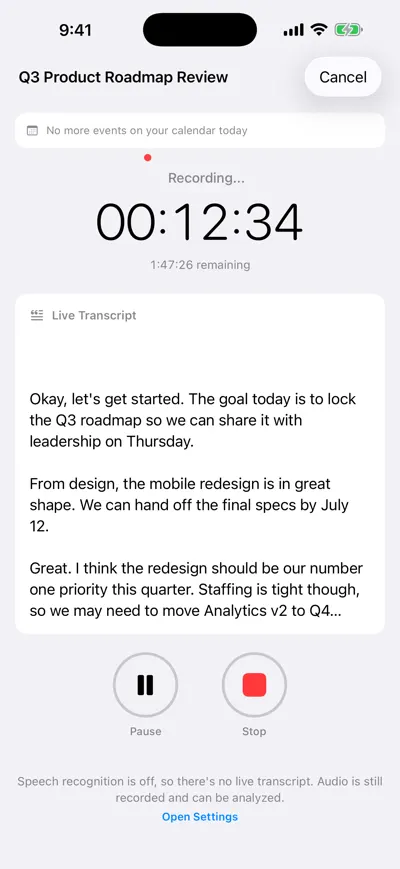
Start recording, then announce it
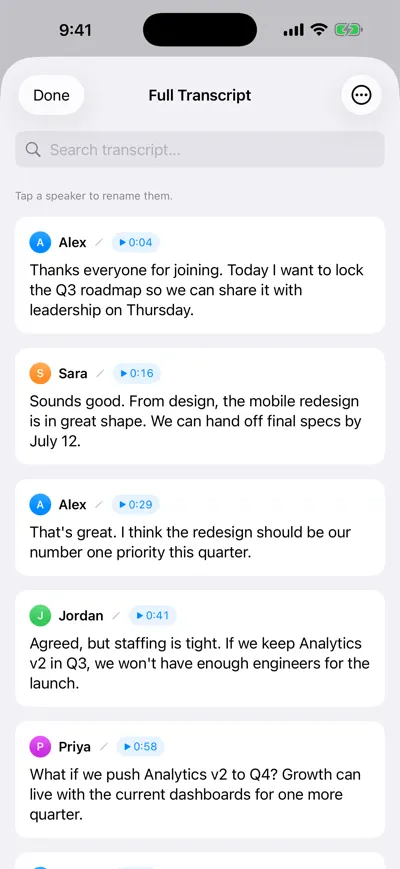
Consent captured at 00:00 in the transcript
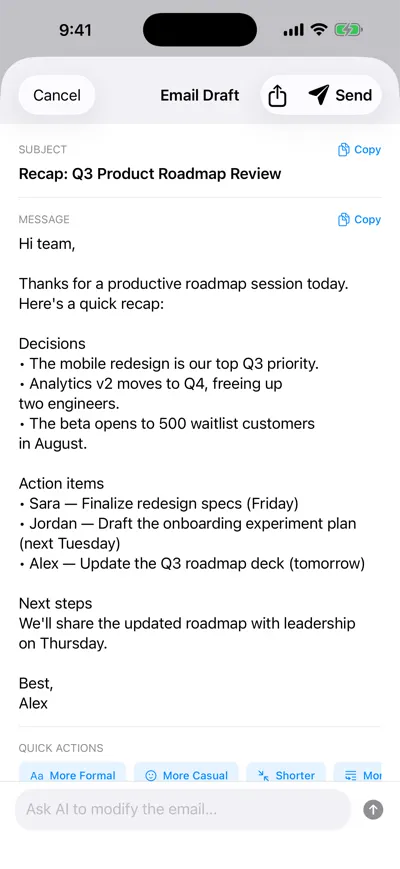
Follow up in writing
Once you have consent, the rest is the usual workflow: record and transcribe the Zoom meeting, turn it into AI meeting notes, and send a recap email. For phone calls specifically, see how to take notes during a phone call.
Frequently asked questions
Let AI take the notes for you
AI Note Taker records and transcribes your meetings, then writes the summary, decisions and action items. Free to start, no install needed.